One piece of timber, sandable for a century. Typical installed cost, durability,
where it works and how to care for it.
$9.00–$22.00 / sq ft installed50–100 year lifeHeavy trafficCommercial ratedWood-look
$9.00–$22.00per sq ft
50–100 yrlife
Heavytraffic
The basics
What is Solid Hardwood?
Solid hardwood flooring is exactly what it sounds like — solid planks of real wood, milled from a tree trunk and nailed down to a wood subfloor. There's no core or backing underneath it; it's wood all the way through. That's what lets it be sanded down and refinished again and again, so a solid hardwood floor can genuinely outlast the house it's in.
Overview
A century of refinishing, one humidity range to respect
Solid hardwood is exactly what it sounds like: 3/4" of a single species, tongue-and-grooved and nailed to a wood subfloor. Its big advantage is renewability — a 3/4" floor can be sanded and refinished 5 to 8 times, so a well-maintained floor can genuinely outlive the people who installed it.
Its big limitation is moisture: wood moves with the seasons as humidity shifts, so solid plank is restricted to on- or above-grade installations over wood subfloors, and the NWFA calls for the interior to be held at 30–50% relative humidity and 60–80 °F.
In real rooms
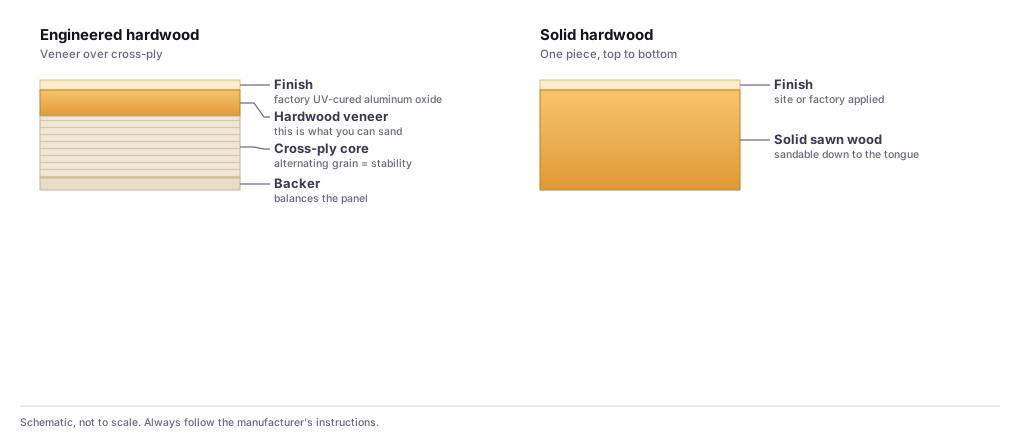
Solid hardwood. One piece of timber through its full thickness, which is exactly what allows it to be sanded and refinished repeatedly across a lifetime. It is also why it moves with humidity and why it is not recommended below grade.
What it costs
Installed cost per square foot
Material / sq ft$5.00–$14.00
Install labor / sq ft$4.00–$8.00
Total installed / sq ft$9.00–$22.00
Expected life50–100 yr$0.21/yr
How it rates
Performance profile
Durability
Water resistance
Comfort underfoot
Sound absorption
Environmental profile
Ease of maintenance
Four separate scores
Living with pets
Claw resistance
Accidents
Traction
Hair & dirt
It will scratch — the useful question is whether you can fix it, and here you can, repeatedly, for decades. Urine is the real threat: it penetrates the grain and blackens the wood below sandable depth, turning a refinishable floor into a replacement.
Solid wood moves too much as the subfloor cycles warm and cool, which is exactly what a radiant system does daily. Nearly every mill excludes it from the warranty over radiant — use engineered instead.
Nail-down is a rentable-tool job on paper, but racking the boards, keeping the first row straight over a room-length run and managing moisture are what actually decide how it looks — then it needs sanding and finishing. Rated 1 of 5 here for a reason.
Only the veneer can be sanded. That is what limits refinishing, not the total thickness.
A dent-resistance scale. Red oak = 1,290 and is the reference point. Hickory 1,820, hard maple 1,450, white oak 1,360, walnut 1,010, southern yellow pine 690, eastern white pine 380. Below ~1,000 expect visible denting in active households.
Plainsawn is standard and shows cathedral grain. Quartersawn and riftsawn cost 25–50% more, move roughly half as much seasonally and produce a tighter, straighter grain.
Prefinished uses aluminum-oxide UV-cured finish — harder and warrantied longer, with micro-bevels at each edge. Site finish gives a seamless, flat surface and lets you match stain exactly, but adds days and VOC exposure.
Wood must sit in the installed space, boxes opened, until its moisture content equilibrates. NWFA guidance is no more than 4% difference between flooring and subfloor for solid strip, and 2% for plank wider than 3 inches. Target 6–9% equilibrium moisture content, which corresponds to 30–50% RH at 60–80 °F. Skipping this is the number one cause of gapping and cupping.
Oil-modified polyurethane ambers over time and is easy to spot-repair. Water-based poly stays clear and cures fast. Hardwax oil penetrates rather than coating — repairable in place but needs periodic re-oiling.
The spec sheet
Key specifications
Thickness
3/4" standard, 5/16" thin
Widths
2¼"–7"+ (wider = more movement)
Refinishes
5–8 over its life
Install
Nail/staple to wood subfloor
Routine
Sweep or dust-mop daily in traffic areas — grit is what abrades finish
Damp-mop with a wood-specific cleaner, barely moist
Hold the interior at 30–50% relative humidity and 60–80 °F year-round — the NWFA range
Felt pads under every furniture leg; replace them annually
Periodic / deep
Screen-and-recoat every 5–10 years — abrades the top finish and adds a fresh coat without removing wood
Full sand-and-refinish only when the wear layer is actually compromised
Never do this
Never wet-mop or use a steam mop — steam drives moisture into the seams
Never use vinegar, ammonia, or oil soap on polyurethane
Never drag furniture; never use rubber-backed mats that trap moisture
Wide planks (6"+) look current but move more seasonally. In a dry climate, expect visible winter gaps unless you humidify.
Each feature paired with the benefit it delivers. A spec on its own tells you nothing about
whether it is worth paying for.
01
Three-quarter inch of solid timber
Five to eight full sandings across its life. This is the only common floor that a new owner in 2075 could make look new again.
02
Species-specific Janka hardness
You can match the floor to the household: hickory at 1,820 for a busy family, walnut at 1,010 where looks lead and traffic is light.
03
Site-finish option
The finish is applied after installation, so the surface is dead flat with no micro-bevels, and the stain can be matched to existing floors exactly.
04
Nail-down installation over wood subfloor
Mechanically fastened rather than glued or floating, which is why it feels solid underfoot and stays silent when the room is walked across.
05
Documented resale premium
The only flooring category buyers consistently pay more for. Refinishing before a sale costs a fraction of replacement and shows as new.
Before you buy
What to confirm on the quote
The specifications below decide how this floor performs. Ask for them in writing — a sample
board and a price per square foot do not tell you any of it.
Thickness: confirm it is 3/4" standard, 5/16" thin
Widths: confirm it is 2¼"–7"+ (wider = more movement)
Refinishes: confirm it is 5–8 over its life
Install: confirm it is Nail/staple to wood subfloor
Substrate: ask what preparation is included and what is excluded
Warranty: ask what is covered after year one, and whether labor is included
Attic stock: order about 5% extra and keep it — replacements bought later rarely match
Solid Hardwood runs $9.00–$22.00 per square foot installed in 2026 — $5.00 to $14.00 for material and $4.00 to $8.00 for professional labor. Spread across an expected 50 to 100 year service life that works out near $0.21 per square foot per year. Regional variation of 20 to 40% is normal, and demolition, subfloor prep and trim are extra.
50 to 100 years, assuming it went into an appropriate room over a properly prepared substrate and gets the maintenance it needs. Wide planks (6"+) look current but move more seasonally. In a dry climate, expect visible winter gaps unless you humidify.
Living / Family Room, Stairs. Main living areas on or above grade. Historic homes and additions to existing wood.
Kitchen, Full Bathroom, Basement (below grade), Entry / Mudroom, Laundry Room, Home Gym. Basements and any below-grade slab. Bathrooms, laundry, mudrooms.
No. Standing water causes permanent damage. Basements and any below-grade slab
Sweep or dust-mop daily in traffic areas — grit is what abrades finish. Damp-mop with a wood-specific cleaner, barely moist. Critically: never wet-mop or use a steam mop — steam drives moisture into the seams.
Alternatives
Compare Solid Hardwood with the alternatives
Same family first, then products with a similar look from other families.