The cheapest fiber that won’t hold water — with a real heat weakness. Typical installed cost, durability,
where it works and how to care for it.
$2.50–$6.50 / sq ft installed5–10 year lifeHeavy trafficCommercial ratedTextile
$2.50–$6.50per sq ft
5–10 yrlife
Heavytraffic
The basics
What is Olefin (Polypropylene) Carpet?
Olefin carpet — also called polypropylene — is carpet made from a plastic fiber that simply won't soak up water, the kind of plastic used in some outdoor rope. It's spun and tufted into a backing like any other carpet, almost always as a looped weave rather than a fluffier cut pile. It's the cheapest common carpet fiber and shrugs off damp rooms, but it can scorch or flatten under heat and dragged furniture.
Overview
Poor memory in the fiber, hidden by a loop weave
Olefin, more precisely polypropylene, is the fiber behind most berber loop carpet and nearly all indoor-outdoor, marine, porch and basement carpet. Its defining trait is chemical: the polymer won't absorb water, so it resists staining, mildew and fading better than any other mainstream fiber, and it's nearly always solution-dyed for that same reason.
What it gives up is resilience — crushed olefin doesn't spring back — which is why it's sold almost exclusively as loop pile rather than cut pile, letting the weave rather than the fiber carry the appearance over time. It also has the lowest melting point of the mainstream fibers, so dragged furniture and friction are a real risk here in a way they simply aren't for nylon or polyester.
In real rooms
Olefin (polypropylene) carpet, almost always sold as a loop or berber weave. The fiber will not absorb water, which is why it turns up on porches and in basements — but it has the lowest melting point of the mainstream fibers, so friction and dragged furniture are its real weakness.
What it costs
Installed cost per square foot
Material / sq ft$1.00–$3.50
Install labor / sq ft$1.50–$3.00
Total installed / sq ft$2.50–$6.50
Expected life5–10 yr$0.60/yr
How it rates
Performance profile
Durability
Water resistance
Comfort underfoot
Sound absorption
Environmental profile
Ease of maintenance
Four separate scores
Living with pets
Claw resistance
Accidents
Traction
Hair & dirt
Almost all olefin is loop pile, and a claw that catches a loop pulls a run exactly as it does on wool — this is a construction risk more than a fiber one. The fiber itself won't absorb an accident, but the pad and subfloor underneath it are exactly as exposed as they are under any other broadloom carpet.
Carpet's pile and pad insulate against the heat, and olefin's low melting point is one more reason to keep the system's surface temperature conservative if you use it here.
In front of a fireplace hearth or anywhere embers or cigarette ash can land
Under a rug pad or mat with rubber backing that traps heat and friction
Formal rooms wanting a plush cut-pile feel
Anywhere heavy furniture will be dragged rather than lifted
Advertisement
How it is built
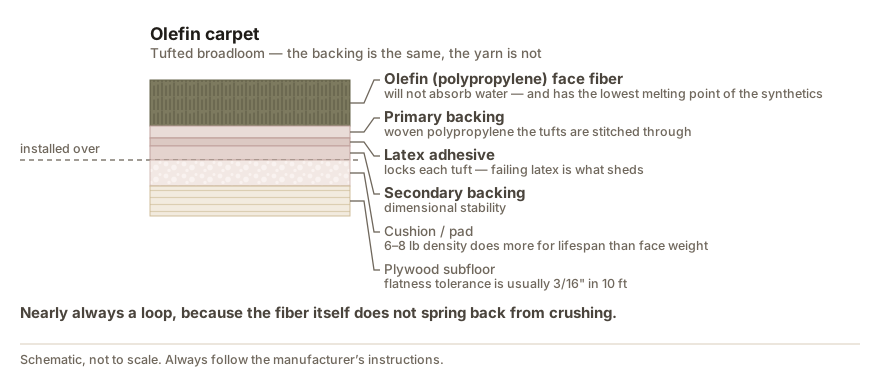
Inside Olefin (Polypropylene) Carpet
Loop, not cut pile — the construction that hides the fiber’s weak crush recovery.
Nearly all olefin is loop or berber for a reason: the fiber has the weakest crush recovery of the mainstream synthetics, and cut pile shows that immediately in a traffic lane. A loop construction doesn't depend on the pile springing back, so the same fiber that would disappoint as cut pile holds its look reasonably well as a loop.
Polypropylene has a lower melting point than nylon or polyester. A dragged piece of furniture, a rubber-backed mat, or even aggressive vacuum friction can glaze or fuse the fiber tips into a permanently shiny, matted patch that no cleaning removes. This is the one failure mode specific to this fiber.
The fiber won't absorb water or feed mold, which is genuinely useful in a damp room. It doesn't change what's underneath, though: standard broadloom over standard pad still traps moisture against a slab exactly as it would with any other fiber. The fiber being moisture-proof doesn't make the installation basement-safe — below grade, a floor with nothing organic in it, such as rigid vinyl plank or tile, is the safer choice.
Like polyester, polypropylene is oil-attracting, so kitchen grease and body oils bond more stubbornly than water-based spills do. A solvent-safe spotter, not a water-based one, is what actually lifts them.
The fiber resists conventional dyeing well enough that most olefin is colored in the melt rather than after tufting. The side effect is a floor that tolerates bleach-based cleaning and won't fade from sun or pool chemicals — the reason it's the standard for indoor-outdoor and marine carpet.
The spec sheet
Key specifications
Typical face weight
20–40 oz/yd²
Warranty range
5–15 yrs
Common construction
Loop / berber
Melting point
Roughly 320–335°F — the lowest of the mainstream fibers
Routine
Vacuum regularly with suction; a beater bar is optional since loop pile doesn’t fuzz the way cut pile can
Blot spills promptly — the fiber won’t absorb them, so most lift with plain water
Keep rubber-backed mats and pads off it long-term to avoid a permanent friction mark
Periodic / deep
Low-moisture or encapsulation cleaning works well since the fiber doesn’t hold water
Hot water extraction is fine but drying time matters less here than on an absorbent fiber
Never do this
Never drag furniture across it — lift it, since friction is this fiber’s specific weakness
Never assume moisture resistance means the pad and subfloor beneath it are also safe
Never use a solvent-based spotter without testing — some can attack the fiber’s surface sheen
The fiber’s real weakness isn’t traffic — it’s friction and heat. Keep rubber mats and dragged furniture off it and a loop olefin floor will outlast its reputation.
Each feature paired with the benefit it delivers. A spec on its own tells you nothing about
whether it is worth paying for.
01
Fiber that won’t absorb water
Polypropylene is chemically hydrophobic all the way through, not just treated to resist spills, so it won’t wick, swell or feed mold and mildew the way an absorbent fiber can.
02
Solution dyeing is close to the only option
The polymer won’t take a topical dye well, so color is almost always locked in at extrusion. The upside of a manufacturing limitation: essentially bleach-proof and immune to fading from sun or chlorine.
03
Loop construction hides its main weakness
The fiber itself has poor crush recovery, but berber and other loop weaves don’t rely on pile springing back the way cut pile does, so the finished floor holds its look far better than the raw fiber's rating suggests.
04
The lowest material cost of any mainstream fiber
Olefin is routinely the cheapest quality carpet on the shelf, which is most of why it dominates builder-grade and low-bid commercial specifications.
05
Naturally low static generation
No topical anti-static treatment needed, which matters in server rooms, labs and anywhere sensitive electronics sit on carpet.
Before you buy
What to confirm on the quote
The specifications below decide how this floor performs. Ask for them in writing — a sample
board and a price per square foot do not tell you any of it.
Typical face weight: confirm it is 20–40 oz/yd²
Warranty range: confirm it is 5–15 yrs
Common construction: confirm it is Loop / berber
Melting point: confirm it is Roughly 320–335°F — the lowest of the mainstream fibers
Substrate: ask what preparation is included and what is excluded
Warranty: ask what is covered after year one, and whether labor is included
Attic stock: order about 5% extra and keep it — replacements bought later rarely match
Olefin (Polypropylene) Carpet runs $2.50–$6.50 per square foot installed in 2026 — $1.00 to $3.50 for material and $1.50 to $3.00 for professional labor. Spread across an expected 5 to 10 year service life that works out near $0.60 per square foot per year. Regional variation of 20 to 40% is normal, and demolition, subfloor prep and trim are extra.
5 to 10 years, assuming it went into an appropriate room over a properly prepared substrate and gets the maintenance it needs. The fiber’s real weakness isn’t traffic — it’s friction and heat. Keep rubber mats and dragged furniture off it and a loop olefin floor will outlast its reputation.
It tolerates water well but has a vulnerability, usually at the seams or the backing. Fine for splashes, not for standing water without care.
Vacuum regularly with suction; a beater bar is optional since loop pile doesn’t fuzz the way cut pile can. Blot spills promptly — the fiber won’t absorb them, so most lift with plain water. Critically: never drag furniture across it — lift it, since friction is this fiber’s specific weakness.
Alternatives
Compare Olefin (Polypropylene) Carpet with the alternatives
Same family first, then products with a similar look from other families.