Softest hand and best value — with a resilience trade-off. Typical installed cost, durability,
where it works and how to care for it.
$3.00–$7.50 / sq ft installed5–12 year lifeModerate trafficTextile
$3.00–$7.50per sq ft
5–12 yrlife
Moderatetraffic
The basics
What is Polyester / PET Carpet?
Polyester carpet — usually just called PET — is carpet made from polyester fiber, the same material as fleece jackets, and it's often spun from recycled plastic bottles. Like any carpet, the fiber is looped or cut and stitched into a backing to create the pile you walk on. It feels soft and holds color well, but it doesn't bounce back from crushing as well as tougher fibers like nylon.
Overview
Water beads off the surface — grease is the real enemy
PET polyester, much of it spun from recycled beverage bottles, is naturally stain-resistant — the fiber is hydrophobic, so a spill sits on the surface instead of soaking in, which is why it shrugs off most household spills better than nylon does. It also takes color beautifully and feels noticeably softer underfoot.
The catch is resilience: polyester doesn't spring back from compression the way nylon does, so traffic lanes flatten sooner, which is why it's a better fit for a bedroom than the routes you walk through a house every day. Triexta (PTT) is a separate, FTC-recognized fiber that closes much of that resilience gap — different enough from PET to have earned its own page.
In real rooms
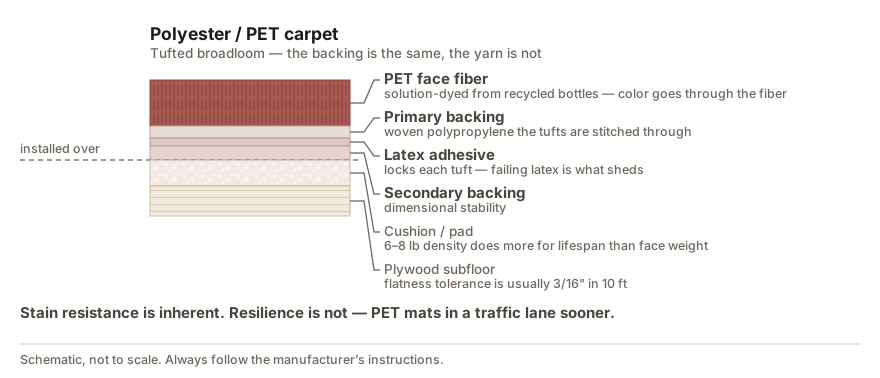
PET polyester carpet, commonly spun from recycled bottle stock. The fiber repels water rather than absorbing it, so it resists most household spills better than nylon does — and it crushes sooner underfoot, which is why it belongs in bedrooms rather than in the routes through a house.
What it costs
Installed cost per square foot
Material / sq ft$1.50–$4.50
Install labor / sq ft$1.50–$3.00
Total installed / sq ft$3.00–$7.50
Expected life5–12 yr$0.62/yr
How it rates
Performance profile
Durability
Water resistance
Comfort underfoot
Sound absorption
Environmental profile
Ease of maintenance
Four separate scores
Living with pets
Claw resistance
Accidents
Traction
Hair & dirt
Solution-dyed polyester shrugs off water-based stains, which is the one pet advantage it has over nylon. It also crushes faster in the traffic lanes a dog wears, and the pad underneath is just as vulnerable to accidents.
Same problem as any carpet: the pile and pad insulate against the heat you're paying to generate. A thin, radiant-rated pad helps; the plush rebond recommended above defeats the system.
Stretched broadloom — tools run roughly $80–$180 to buy
A room in a day with the right tools. Same stretching rule as any broadloom carpet: a power stretcher, not a knee kicker, is what holds the seam and keeps the pile from rippling.
Stain resistance is built into the fiber. Resilience is not.
Standard PET is the value play. Triexta is a separate fiber generic with a permanent, built-in stain barrier and resilience that runs closer to nylon — worth the step up in price if the extra traffic-lane performance matters. See the dedicated triexta carpet page for the full comparison.
Most PET carpet contains 25–100% post-consumer recycled bottle content, which is a real embodied-carbon advantage and a common green-building credit.
Because the fiber is oil-loving, greasy soils bond to PET more stubbornly than to nylon. Kitchens and pet areas need prompt treatment with a solvent-safe spotter.
Ultra-soft PET uses very fine filaments for a luxurious hand, but finer filaments mat faster. Ask for the density number, not just "soft."
The spec sheet
Key specifications
Typical face weight
30–60 oz/yd²
Warranty range
5–15 yrs
Recycled content
Up to 100% post-consumer
Best sub-type
Triexta / PTT for durability
Routine
Vacuum weekly; use suction-only or a gentle brush on ultra-soft styles to avoid fuzzing
Treat oil-based spills fast with a solvent spotter, then rinse
Keep pile height moderate in any room you actually walk through
Periodic / deep
Low-moisture extraction every 12–18 months
Avoid excessive detergent — residue attracts soil and PET holds residue stubbornly
Never do this
Never use a high-pile beater-bar setting on ultra-soft PET
Never assume "stain-resistant" means grease-resistant
Never install on stairs if you expect 10-year performance
PET is the right answer for bedrooms and the wrong answer for stairs. Mixing fibers by room is a legitimate, cost-effective strategy.
Each feature paired with the benefit it delivers. A spec on its own tells you nothing about
whether it is worth paying for.
01
Hydrophobic polyester fiber
Water-based spills bead on the surface instead of wicking in, so wine, juice and coffee blot up with far less drama than on an untreated fiber.
02
Recycled bottle content, often 100%
Real embodied-carbon reduction and an easy green-building credit, at no performance cost versus virgin PET.
03
Fine-denier filaments
A genuinely softer hand than nylon at the same price. In a bedroom, where traffic is light, that softness is the point.
04
Deep, saturated dye uptake
Color options and clarity that nylon struggles to match, which is why the most fashion-forward carpet styles tend to be polyester.
05
Lowest entry price of any quality carpet
Puts a full house of new carpet within reach on a rental or flip budget, provided you keep it off the stairs.
Before you buy
What to confirm on the quote
The specifications below decide how this floor performs. Ask for them in writing — a sample
board and a price per square foot do not tell you any of it.
Typical face weight: confirm it is 30–60 oz/yd²
Warranty range: confirm it is 5–15 yrs
Recycled content: confirm it is Up to 100% post-consumer
Best sub-type: confirm it is Triexta / PTT for durability
Substrate: ask what preparation is included and what is excluded
Warranty: ask what is covered after year one, and whether labor is included
Attic stock: order about 5% extra and keep it — replacements bought later rarely match
Polyester / PET Carpet runs $3.00–$7.50 per square foot installed in 2026 — $1.50 to $4.50 for material and $1.50 to $3.00 for professional labor. Spread across an expected 5 to 12 year service life that works out near $0.62 per square foot per year. Regional variation of 20 to 40% is normal, and demolition, subfloor prep and trim are extra.
5 to 12 years, assuming it went into an appropriate room over a properly prepared substrate and gets the maintenance it needs. PET is the right answer for bedrooms and the wrong answer for stairs. Mixing fibers by room is a legitimate, cost-effective strategy.
Bedroom. Bedrooms and low-traffic living areas. Rental and flip properties.
Stairs, Entry / Mudroom, Home Office. Stairs and main hallways. Commercial corridors.
No. Standing water causes permanent damage. Keep it out of wet areas.
Vacuum weekly; use suction-only or a gentle brush on ultra-soft styles to avoid fuzzing. Treat oil-based spills fast with a solvent spotter, then rinse. Critically: never use a high-pile beater-bar setting on ultra-soft pet.
Alternatives
Compare Polyester / PET Carpet with the alternatives
Same family first, then products with a similar look from other families.