Seamless, welded, genuinely impermeable — the healthcare standard. Typical installed cost, durability,
where it works and how to care for it.
$3.00–$9.00 / sq ft installed10–25 year lifeExtreme trafficCommercial ratedWood-look, Stone & marble, Solid & pattern
$3.00–$9.00per sq ft
10–25 yrlife
Extremetraffic
The basics
What is Sheet Vinyl?
Sheet vinyl is exactly what it sounds like — flooring that comes in one big, flexible roll, like a giant sheet of linoleum, instead of individual planks or tiles. It's rolled out and glued down, and because a typical room is covered by one continuous piece, there are few or no seams for water to get through. That's why you'll see it in hospitals, laundry rooms and other places that get wet.
Overview
One continuous sheet — cut it right, there is no second piece
Sheet vinyl comes in 6- or 12-foot-wide rolls, so a typical room ends up with few or no seams — and in commercial installations, those seams get heat-welded with a matching rod while the material is coved up the wall, creating a monolithic waterproof basin that a grouted floor simply can't match. Nothing else at this price point offers that, but it cuts both ways: the sheet has to be cut right the first time, because there's no second attempt on one piece.
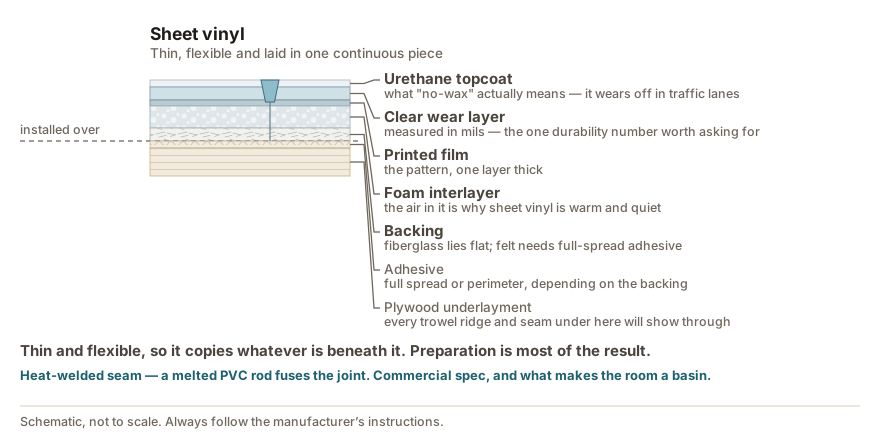
Homogeneous sheet carries the color through its full thickness, so wear doesn't change its appearance; heterogeneous sheet is layered with a printed film and a clear wear layer, which allows richer visuals — including convincing printed tile or stone patterns — at a lower cost.
In real rooms
Sheet vinyl. Those tile joints are printed, not real — the floor is one continuous piece cut from a roll, which is exactly why it holds up in a kitchen, bathroom or laundry where a grouted floor gives water a way in. It is also why the cut has to be right first time; there is no second attempt on one piece.
What it costs
Installed cost per square foot
Material / sq ft$1.50–$5.00
Install labor / sq ft$1.50–$4.00
Total installed / sq ft$3.00–$9.00
Expected life10–25 yr$0.34/yr
How it rates
Performance profile
Durability
Water resistance
Comfort underfoot
Sound absorption
Environmental profile
Ease of maintenance
Four separate scores
Living with pets
Claw resistance
Accidents
Traction
Hair & dirt
The best accident floor at a domestic price, and it's not close: heat-welded seams and a coved base turn the room into a basin with nowhere for urine to go. Softer than plank vinyl, so a determined claw can gouge it, but nothing else handles a dog that has trouble holding it.
Thin and flexible enough to conduct well. Confirm the manufacturer's surface-temperature limit — typically 80–85°F — before specifying it over a hydronic or electric system. Manufacturer surface-temperature limit: about 85°F.
Glue-down, ordinary seams — tools run roughly $100–$250 to buy
Not the constraint — the adhesive's open time is. A basic glue-down with ordinary seams is doable. Heat-welded seams and an integral coved base are a trade skill with trade tools — that version is a professional job, not a DIY one.
Ask for the wear layer in mils. Everything above it wears off.
Homogeneous = single-color-through construction, restorable by buffing, used in healthcare. Heterogeneous = printed layer + wear layer, better visuals, replace rather than restore.
A grooved seam filled with a melted PVC rod, producing a joint as impermeable as the field. Required in most healthcare and food-service spec.
The sheet is turned up the wall over a cove stick, eliminating the floor-wall joint entirely. This is what makes a room genuinely washable.
Glue-down sheet is unforgiving of slab moisture — adhesive failure and bubbling follow. ASTM F2170 RH testing isn't optional.
Factory-applied polyurethane coatings eliminate the need for wax, cutting lifecycle maintenance cost dramatically versus VCT.
The spec sheet
Key specifications
Roll widths
6 ft, 12 ft, 13.1 ft
Thickness
1.5–3.0 mm
Seams
Heat-welded (commercial)
Wear layer
PUR-coated common
Routine
Dust-mop then damp-mop with a neutral cleaner
Immediately address spills of solvents or dyes
Protective floats under all heavy point loads
Periodic / deep
Spray-buff or restore with a manufacturer-approved finish on homogeneous products
Deep scrub and recoat only if the product is designed for coatings
Never do this
Never use solvent-based cleaners or abrasive powders
Never use rubber-backed mats
Never install over a slab that hasn’t been moisture tested
For a laundry room or basement bath on a budget, welded sheet vinyl with coved base is more waterproof than tile — grout isn't waterproof, and sheet has no grout.
Each feature paired with the benefit it delivers. A spec on its own tells you nothing about
whether it is worth paying for.
01
Six- or twelve-foot roll widths
Most rooms take one piece with no seams at all. Nothing else at this price gives you a floor with no joints for water to find.
02
Heat-welded seams
Where a seam is unavoidable, a melted PVC rod fuses it into a joint as impermeable as the field. This is why it is still specified in operating theaters.
03
Integral coved base
The sheet turns up the wall over a cove stick, eliminating the floor-wall joint and turning the room into a washable basin.
04
Homogeneous through-color construction
Color runs the full thickness, so wear doesn’t change appearance and the surface can be restored by buffing rather than replaced.
05
Factory PUR coating
No wax, ever. Removes the strip-and-refinish cycle that makes cheaper hard floors expensive to own.
Before you buy
What to confirm on the quote
The specifications below decide how this floor performs. Ask for them in writing — a sample
board and a price per square foot do not tell you any of it.
Roll widths: confirm it is 6 ft, 12 ft, 13.1 ft
Thickness: confirm it is 1.5–3.0 mm
Seams: confirm it is Heat-welded (commercial)
Wear layer: confirm it is PUR-coated common
Substrate: ask what preparation is included and what is excluded
Warranty: ask what is covered after year one, and whether labor is included
Attic stock: order about 5% extra and keep it — replacements bought later rarely match
Sheet Vinyl runs $3.00–$9.00 per square foot installed in 2026 — $1.50 to $5.00 for material and $1.50 to $4.00 for professional labor. Spread across an expected 10 to 25 year service life that works out near $0.34 per square foot per year. Regional variation of 20 to 40% is normal, and demolition, subfloor prep and trim are extra.
10 to 25 years, assuming it went into an appropriate room over a properly prepared substrate and gets the maintenance it needs. For a laundry room or basement bath on a budget, welded sheet vinyl with coved base is more waterproof than tile — grout isn't waterproof, and sheet has no grout.
Kitchen, Full Bathroom, Entry / Mudroom, Laundry Room. Hospitals, clinics, labs, commercial kitchens. Laundry rooms and basements.
Living / Family Room. Projects wanting a premium or realistic wood look. Subfloors with unevenness (telegraphs badly).
Yes — sheet vinyl is unaffected by water, which is why it works in bathrooms, laundries and below grade. Note that a waterproof material does not make a waterproof floor: water can still travel through seams to the subfloor beneath.
Dust-mop then damp-mop with a neutral cleaner. Immediately address spills of solvents or dyes. Critically: never use solvent-based cleaners or abrasive powders.
Alternatives
Compare Sheet Vinyl with the alternatives
Same family first, then products with a similar look from other families.