Marble, travertine, slate, limestone, granite — no two alike. Typical installed cost, durability,
where it works and how to care for it.
$11.00–$50.00 / sq ft installed50–100 year lifeHeavy trafficCommercial ratedStone & marble
$11.00–$50.00per sq ft
50–100 yrlife
Heavytraffic
The basics
What is Natural Stone?
Natural stone flooring is real stone — marble, granite, slate, travertine or limestone — cut into slabs or tiles straight from a quarry, not manufactured to look like stone. Because it's a natural material, no two pieces look exactly alike, and it needs periodic sealing to protect it. It's also one of the only floors that can run seamlessly from indoors out onto a patio.
Overview
Unmatched beauty, uncompromising requirements
Quarried from the earth, natural stone offers a look that manufactured products simply cannot duplicate. Because every piece is inherently unique, exact replacements for damaged tiles are impossible to find.
If you choose natural stone, you must choose the right type for your lifestyle: granite offers near-bulletproof density, slate provides slip-resistant durability, while porous travertine and acid-sensitive marble require much more care. The installation and maintenance are just as strict: every natural stone floor requires periodic chemical sealing and a subfloor that is twice as stiff as what is required for standard ceramic tile.
In real rooms
Natural stone. Every piece differs because it was quarried rather than manufactured — which is both the appeal and the difficulty. It is porous and needs sealing, pieces are not interchangeable, and it asks roughly twice the substrate stiffness that ceramic does.
What it costs
Installed cost per square foot
Material / sq ft$4.00–$30.00
Install labor / sq ft$7.00–$20.00
Total installed / sq ft$11.00–$50.00
Expected life50–100 yr$0.41/yr
How it rates
Performance profile
Durability
Water resistance
Comfort underfoot
Sound absorption
Environmental profile
Ease of maintenance
Four separate scores
Living with pets
Claw resistance
Accidents
Traction
Hair & dirt
Depends enormously on the stone. Slate is textured and forgiving; polished marble and limestone are soft, slippery, and etch permanently where urine sits. Any stone in a pet household needs sealing and re-sealing, and that's a maintenance commitment rather than a one-off.
Excellent thermal mass — it holds the system's warmth and releases it slowly. Bring the temperature up gradually on stone with natural fissures; rapid swings, not the radiant system itself, are what cause thermal cracking.
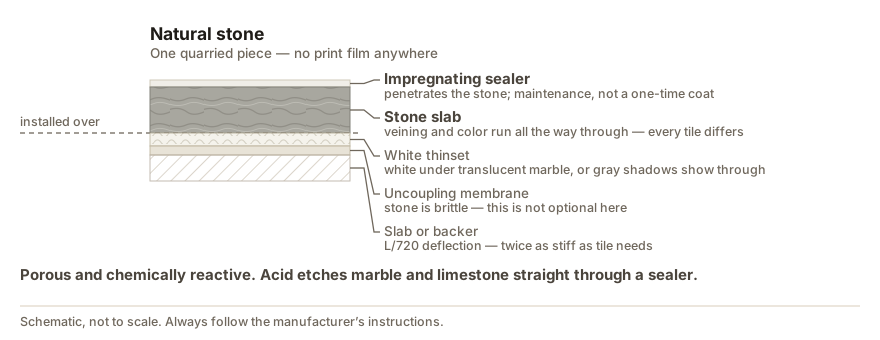
Laid like tile and far less forgiving — brittle, heavy, often calibrated inconsistently, and it wants roughly double the substrate stiffness ceramic does (L/720 versus L/360). A cutting mistake wastes material that has no matching replacement piece.
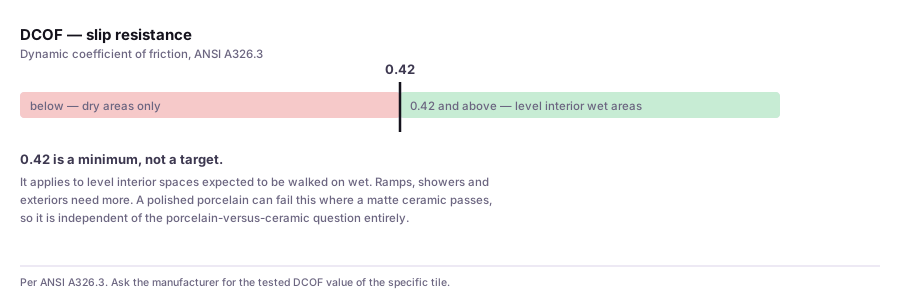
One solid piece, which is why it can be refinished and why it stains.0.42 is a floor, not a target. Ramps and showers need more.
Calcareous stones (marble, limestone, travertine, onyx) react with acid and etch — a dull mark that is physical damage, not a stain. Siliceous stones (granite, slate, quartzite, sandstone) are acid-resistant.
A stain is absorbed material and can often be drawn out with a poultice. An etch is dissolved surface and requires re-polishing. Sealer prevents stains; it doesn't prevent etching.
Polished (reflective, slippery when wet, shows etching most), honed (matte, hides etching, needs sealing more often), tumbled and brushed (textured, best slip resistance).
Impregnating (penetrating) sealers sit below the surface and don't change appearance — the standard choice. Topical sealers add sheen but wear and must be stripped.
Order 10–15% overage and dry-lay the entire floor before setting to distribute color and veining. Stone that isn't laid out first frequently looks blotchy.
Stone is heavy. Verify floor framing and deflection, especially for thick slabs and second-floor applications.
The spec sheet
Key specifications
Common types
Granite, marble, travertine, slate, limestone
Sealing
Every 1–3 years
Overage
Order 10–15%
Outdoor
Yes with correct stone/finish
Routine
Dust-mop daily — grit scratches polished stone quickly
If you want marble in a kitchen, decide up front that you love patina. Etching in a working kitchen is inevitable, not a maintenance failure.
Each feature paired with the benefit it delivers. A spec on its own tells you nothing about
whether it is worth paying for.
01
Quarried, not manufactured
Every piece is unique and no printing process can replicate it. That uniqueness is the entire value proposition and it doesn’t date.
02
Full-depth material
Marble and granite can be honed and re-polished repeatedly, so a 100-year-old stone floor is restored rather than replaced.
03
Exceptional thermal mass
Holds warmth from a radiant system and stays cool in summer heat, which is why it is traditional in hot climates.
04
Genuine outdoor capability
The right stone runs from an interior hall out to a terrace with no change of material, which no printed product can honestly imitate.
05
Finish choices that change everything
Polished, honed, tumbled and brushed produce dramatically different looks and slip performance from the same quarried block.
Before you buy
What to confirm on the quote
The specifications below decide how this floor performs. Ask for them in writing — a sample
board and a price per square foot do not tell you any of it.
Common types: confirm it is Granite, marble, travertine, slate, limestone
Sealing: confirm it is Every 1–3 years
Overage: confirm it is Order 10–15%
Outdoor: confirm it is Yes with correct stone/finish
Substrate: ask what preparation is included and what is excluded
Warranty: ask what is covered after year one, and whether labor is included
Attic stock: order about 5% extra and keep it — replacements bought later rarely match
Natural Stone runs $11.00–$50.00 per square foot installed in 2026 — $4.00 to $30.00 for material and $7.00 to $20.00 for professional labor. Spread across an expected 50 to 100 year service life that works out near $0.41 per square foot per year. Regional variation of 20 to 40% is normal, and demolition, subfloor prep and trim are extra.
50 to 100 years, assuming it went into an appropriate room over a properly prepared substrate and gets the maintenance it needs. If you want marble in a kitchen, decide up front that you love patina. Etching in a working kitchen is inevitable, not a maintenance failure.
Full Bathroom, Entry / Mudroom, Sunroom / Four-Season Room. Entries, formal spaces and feature areas. High-end residential and hospitality.
Stairs, Home Office, Home Gym. Kitchens if the stone is marble or limestone. Owners unwilling to reseal on schedule.
No. Standing water causes permanent damage. Keep it out of wet areas.
Dust-mop daily — grit scratches polished stone quickly. Clean only with a stone-specific neutral cleaner. Critically: never use vinegar, lemon, bleach or generic bathroom cleaners.
Alternatives
Compare Natural Stone with the alternatives
Same family first, then products with a similar look from other families.