Photographic layer over HDF — the scratch-resistance champion. Typical installed cost, durability,
where it works and how to care for it.
$3.50–$11.00 / sq ft installed15–25 year lifeHeavy trafficCommercial ratedWood-look, Stone & marble
$3.50–$11.00per sq ft
15–25 yrlife
Heavytraffic
The basics
What is Laminate?
Laminate isn't real wood at all — it's a printed photograph of wood or stone, sealed under a hard, clear wear layer and bonded onto a dense fiberboard core. The planks click together without any glue or nails, like puzzle pieces. It can look convincingly like wood from a few feet away, and it actually resists scratches better than real hardwood does.
Overview
Harder than hardwood on top, and now sometimes waterproof too
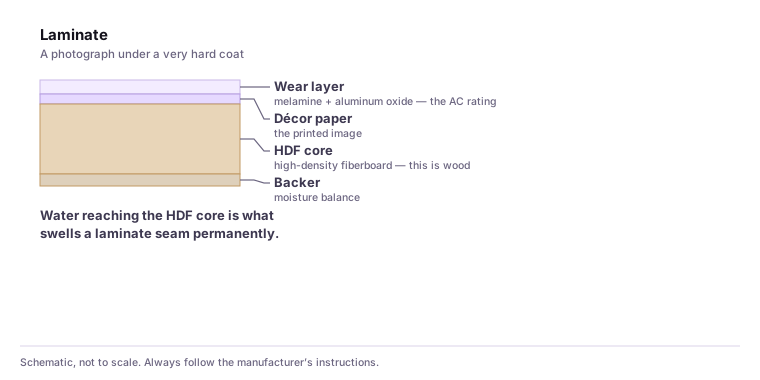
Laminate is a printed decorative paper laminated under a melamine wear layer infused with aluminum oxide, all bonded to a high-density fiberboard core — a limited set of printed patterns, which is why you'll eventually spot the grain repeating across a large floor. That wear layer is genuinely harder than any wood finish, which is why laminate actually outperforms real hardwood on scratch and scuff resistance — a real plus if you've got dogs.
Modern embossed-in-register texture lines the surface texture up with the printed grain, which makes current products far more convincing than the shiny laminate of the 1990s.
The old weakness was the HDF core, which swells irreversibly once water reaches a seam — so what happens at the seams matters more than what happens on the surface, and that's still true of the cheap tier. The category has since split in two: sealed-core products treat the board on all six faces and carry a written waterproof warranty, so “laminate” now describes two products that behave very differently around water.
In real rooms
Laminate. The grain is a printed photographic layer under a hard melamine wear surface, sitting on a fiberboard core. The print is why a pattern eventually repeats across a large floor, and the core is why what happens at the seams matters more than what happens on the surface.
What it costs
Installed cost per square foot
Material / sq ft$1.50–$6.00
Install labor / sq ft$2.00–$5.00
Total installed / sq ft$3.50–$11.00
Expected life15–25 yr$0.36/yr
How it rates
Performance profile
Durability
Water resistance
Comfort underfoot
Sound absorption
Environmental profile
Ease of maintenance
Four separate scores
Living with pets
Claw resistance
Accidents
Traction
Hair & dirt
The most claw-resistant wood-look there is — AC4 and AC5 wear layers are genuinely hard to mark. Accidents depend entirely on which tier you buy, and the category has split in two: standard laminate has a bare HDF core that swells irreversibly once liquid reaches a seam, while the sealed-core tier treats the board on all six faces and carries a written waterproof warranty, some of them naming pet urine specifically. Ask which one you're being quoted, and get the warranty in writing — the two look identical on a sample board.
Most HDF-core laminate is rated for radiant use — confirm the specific line, keep the surface under about 80–85°F, and bring the system up gradually rather than all at once. Manufacturer surface-temperature limit: about 85°F.
Floating click — tools run roughly $150–$400 to buy
A bedroom in a day; a whole floor over a long weekend. One of the most DIY-friendly floors made. The expansion gap and a square first row are the whole job — get those right and the rest follows.
Bathrooms and laundries, unless it is the sealed-core tier with a written waterproof warranty
Below-grade slabs without vapor barrier
Homes wanting resale value from flooring
Anywhere refinishing might be desired
Advertisement
How it is built
Inside Laminate
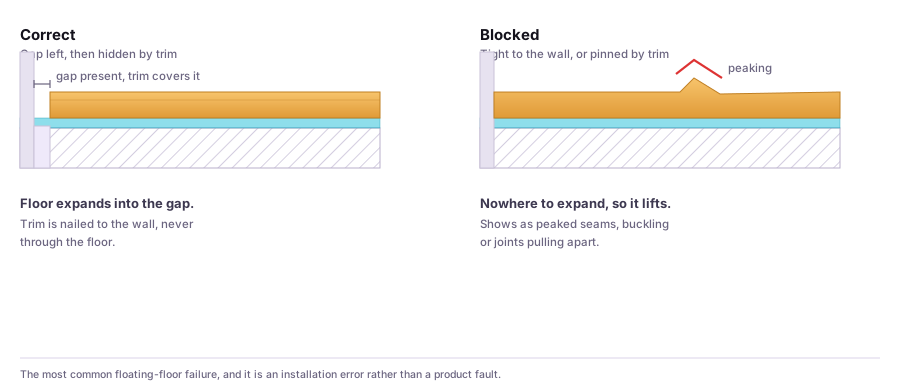
The core is wood, and the lock is cut into it. Which tier you buy decides whether that matters.The most common floating-floor failure, and an installation error rather than a product fault.
From the European EN 13329 standard, measured in Taber abrasion cycles: AC3 (heavy domestic / moderate commercial) ≥ 2,500 cycles, AC4 (general commercial) ≥ 4,000, AC5 (heavy commercial) ≥ 6,500, with AC6 above that. Note that AC is a European classification adopted into North American marketing — the North American standard, NALFA LF-01, certifies to its own levels and doesn't use AC numbers. AC measures surface abrasion only, not impact, moisture or joint strength. For a busy household, buy AC4 or better; the cost delta is small.
Surface texture physically aligned to the printed grain. This is the difference between "obviously fake" and "you have to look twice."
Three tiers, and the gap between them is now wider than the price gap. The bottom tier is untreated HDF — it swells on contact, and the warranty excludes water damage by name. The middle tier seals the edges with wax and hydrophobic resin and backs it with a 24-hour standing-water warranty, the baseline most lines calling themselves “waterproof” actually carry. The top tier treats all six faces and the joint, stretches that window to 72 hours, and increasingly names wet-mopping and pet accidents as covered rather than excluded. Ask which tier the quote is for, and how many hours are attached to the word “waterproof” — the three look indistinguishable on a sample board.
The two specs are earned separately but marketed together, so it's easy to assume a “waterproof” line is automatically the toughest one on the lot. It isn't necessarily — a line built around a strong water warranty can carry only an AC3 rating, the entry-level threshold, while a plainer water-resistant-only line next to it carries AC5. Ask for both numbers on their own; neither implies the other.
Unlike waterproof claims on outerwear or footwear, nothing forces a flooring line to prove the claim before printing it on the box. NALFA — the same trade group behind the LF-01 abrasion standard above — has published a joint-swell test method attempting to define it, but that test measures swelling at the seam, not a flooded room. A burst supply line or an unattended pet accident can outlast what the test checks for. Treat “waterproof” as marketing language until it comes with a specific number of hours attached, in writing.
Angle-tap, drop-lock and fold-down systems. All are glueless and floating, which means the floor must be able to move: leave a 1/4"–3/8" expansion gap at every wall and vertical obstruction.
Determines acoustics and comfort. Combination pad-plus-vapor-barrier is standard over concrete. Attached pad saves a step but is usually thinner than what you would buy separately.
The spec sheet
Key specifications
Thickness
7–12 mm
Wear rating
AC3–AC5 (EN 13329)
Install
Floating click-lock
Refinishable
No
Routine
Dry sweep or vacuum with a hard-floor head
Damp — never wet — mop with a laminate-specific cleaner
Wipe spills immediately, especially at seams
Walk-off mats at exterior doors
Periodic / deep
There is no deep-clean or refinish option; laminate is a replace-not-repair product
Individual planks can be swapped if the floor is floating and you saved attic stock
Never do this
Never steam-mop — heat and moisture destroy the core and delaminate the wear layer
Never wet-mop or use a bucket
Never use wax, polish or oil soap; they leave a haze that can’t be removed
Ask which tier you're being quoted, and how many hours of standing water the warranty actually covers. Standard laminate fails exactly as it always did — the core is wood and a wet seam ends it. Sealed-core laminate is a genuinely different product with a written waterproof warranty, and the two look identical on a sample board. If the warranty isn't in writing with a number attached, assume the cheap tier.
Each feature paired with the benefit it delivers. A spec on its own tells you nothing about
whether it is worth paying for.
01
Aluminum-oxide impregnated melamine surface
Genuinely harder than any wood finish. If you have a large dog, laminate will out-scratch real hardwood for a third of the price.
02
AC4 or AC5 abrasion rating
A published, tested number in Taber cycles rather than a marketing claim. AC4 survives 4,000; AC5 survives 6,500.
03
Embossed-in-register texture
Surface grain physically aligned to the printed grain. This is the difference between obviously fake and having to crouch down to tell.
04
Glueless click-lock installation
A competent DIYer floors a bedroom in an afternoon with a saw and a tapping block. Labor is often the largest line item you can delete.
05
High-density fiberboard core
Rigid and flat underfoot with none of the hollow flex of thin vinyl, and dimensionally stable across normal indoor temperature swings.
Before you buy
What to confirm on the quote
The specifications below decide how this floor performs. Ask for them in writing — a sample
board and a price per square foot do not tell you any of it.
Thickness: confirm it is 7–12 mm
Wear rating: confirm it is AC3–AC5 (EN 13329)
Install: confirm it is Floating click-lock
Refinishable: confirm it is No
Substrate: ask what preparation is included and what is excluded
Warranty: ask what is covered after year one, and whether labor is included
Attic stock: order about 5% extra and keep it — replacements bought later rarely match
Laminate runs $3.50–$11.00 per square foot installed in 2026 — $1.50 to $6.00 for material and $2.00 to $5.00 for professional labor. Spread across an expected 15 to 25 year service life that works out near $0.36 per square foot per year. Regional variation of 20 to 40% is normal, and demolition, subfloor prep and trim are extra.
15 to 25 years, assuming it went into an appropriate room over a properly prepared substrate and gets the maintenance it needs. Ask which tier you're being quoted, and how many hours of standing water the warranty actually covers. Standard laminate fails exactly as it always did — the core is wood and a wet seam ends it. Sealed-core laminate is a genuinely different product with a written waterproof warranty, and the two look identical on a sample board. If the warranty isn't in writing with a number attached, assume the cheap tier.
Kitchen, Full Bathroom, Basement (below grade), Stairs, Entry / Mudroom, Laundry Room, Home Gym, Garage / Workshop, Sunroom / Four-Season Room. Bathrooms and laundries, unless it is the sealed-core tier with a written waterproof warranty. Below-grade slabs without vapor barrier.
It depends which laminate, and that is a real answer rather than a hedge. Standard laminate isn’t waterproof and never has been — water reaching the fiberboard core through a seam causes swelling that doesn’t reverse. “Waterproof” laminate is real, but the word itself is unregulated marketing language wrapped around warranties that actually range from 24 hours of standing water on the entry sealed-core tier to 72 hours with no exclusions on the top tier — nothing requires a manufacturer to say which one is being sold. Both are sold as laminate at similar prices, so ask for the number of hours in writing rather than trusting the word.
Dry sweep or vacuum with a hard-floor head. Damp — never wet — mop with a laminate-specific cleaner. Critically: never steam-mop — heat and moisture destroy the core and delaminate the wear layer.
Alternatives
Compare Laminate with the alternatives
Same family first, then products with a similar look from other families.