The commercial carpet: offices, schools, healthcare. Replaced a square at a time. Typical installed cost, durability,
where it works and how to care for it.
$3.00–$9.50 / sq ft installed10–20 year lifeExtreme trafficCommercial ratedTextile
$3.00–$9.50per sq ft
10–20 yrlife
Extremetraffic
The basics
What is Carpet Tile (Modular)?
Carpet tile is carpet made in small individual squares instead of one continuous roll. Each square sits on the floor on its own, held down loosely or with a light adhesive, so a stained or damaged square lifts out and a fresh one drops in without touching the rest of the floor. That's why it's the standard carpet in offices, schools and healthcare — and why this site treats it as a commercial product rather than a choice for a house.
Overview
Damage one tile, replace one tile, done
Modular carpet tile — typically 19.7" (50 cm) squares or 25×100 cm planks — goes down loose or with releasable adhesive instead of being stretched over pad, and it needs no stretching at all, which is why a facilities crew can lay it and relay it in-house.
That same releasable construction changes the whole maintenance picture: a stained or damaged tile lifts right out and a replacement drops in without disturbing its neighbors — repairable a square foot at a time, something no other soft floor here lets you do. Modern tiles use a dimensionally stable backing (often PVC-free) with an attached cushion, so acoustics are good and the product handles slab moisture far better than broadloom.
In real rooms
Carpet tile. Laid loose or on a releasable adhesive, so a damaged tile lifts out and a replacement drops in without disturbing its neighbors — the only soft floor here you can repair a square foot at a time, and the only one an ordinary person can install well.
What it costs
Installed cost per square foot
Material / sq ft$2.00–$7.00
Install labor / sq ft$1.00–$2.50
Total installed / sq ft$3.00–$9.50
Expected life10–20 yr$0.42/yr
How it rates
Performance profile
Durability
Water resistance
Comfort underfoot
Sound absorption
Environmental profile
Ease of maintenance
Four separate scores
Living with pets
Claw resistance
Accidents
Traction
Hair & dirt
Scored for the commercial spaces that have animals in them — veterinary waiting rooms, pet retail, grooming. Most modular backings are impermeable, so an accident stays in one tile, and that tile lifts out and gets replaced. It is not put forward here as a way to have carpet in a house.
Thinner than broadloom and usually glued without a separate cushion, so it passes more of the system's heat than a padded carpet does — still not as efficient as a hard surface.
Peel-and-stick or releasable tile — tools run roughly $40–$90 to buy
A room in an afternoon, and you can stop halfway and come back. The easiest floor here to lay, which is why facilities crews relay it in-house. A commercial product, so it is not among the DIY kits on this site.
Any commercial space where spot replacement matters
Where to think twice
Homes — a commercial product this site does not put forward for a house
Wet areas
Installations over uneven or dusty slabs
Advertisement
How it is built
Inside Carpet Tile (Modular)
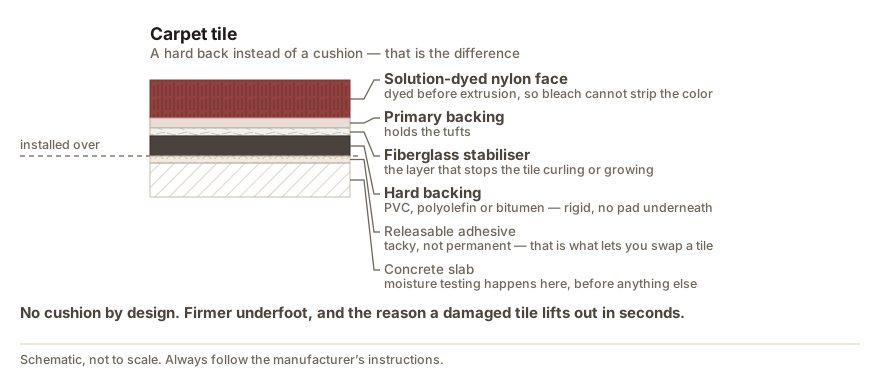
The fiberglass layer is why a tile stays flat and square.
A pressure-sensitive tacky adhesive that holds tiles down but allows lift-and-replace. Not a permanent glue — this is what makes the system modular.
Closed-cell cushion backings (e.g., ethylene-based) block moisture vapor, resist delamination and add acoustic value. PVC-free backings are now the norm in green spec.
Standard commercial practice is to order 5% extra and store it. When a tile is damaged years later, the replacement matches — no dye-lot problem.
Quarter-turn, monolithic, ashlar and brick patterns from the same tile produce very different looks and hide traffic patterns differently.
Many modular backings are warranted over slabs with elevated RH where broadloom and glue-down hard surface would fail — verify the specific product's limit.
The spec sheet
Key specifications
Common sizes
19.7" sq, 9.8×39.4", 25×100 cm
Backing
Cushion, hardback, PVC-free options
Warranty
10–20 yrs commercial
Recycled content
Frequently 40–90%
Routine
Vacuum with a commercial upright; modular backings tolerate aggressive beater bars
Spot-clean immediately; lift and replace irreparably stained tiles
Rotate tiles from low-traffic areas into worn spots to extend life
Periodic / deep
Encapsulation cleaning quarterly-to-annually in commercial use
Hot water extraction annually in heavy-soil environments
Never do this
Never over-wet — moisture trapped under a closed-cell backing has nowhere to go
Never install over a slab without a calcium chloride or RH probe test
Never mix dye lots without checking under actual lighting
A commercial product: order 5% attic stock at bid so a tile damaged years later still matches. For a house, broadloom over pad is the carpet this site recommends.
Each feature paired with the benefit it delivers. A spec on its own tells you nothing about
whether it is worth paying for.
01
Releasable pressure-sensitive adhesive
Lift a ruined tile with a suction cup and drop in a replacement in under a minute. A flood costs you twelve tiles instead of a whole room.
02
Closed-cell cushion backing
Blocks moisture vapor from below, so it goes over slabs that would destroy broadloom and pad — the reason it is the default carpet on a ground-floor commercial slab.
03
Dimensionally stable construction
No stretching, no seams to peak, no re-stretching call-backs. It lies flat on day one and stays flat.
04
Rotatable inventory
Swap worn tiles from a traffic lane with fresh ones from under a desk and the floor evens out. No other carpet lets you redistribute wear.
05
Quarter-turn and ashlar patterns
One tile yields several very different looks, and directional laying disguises soiling far better than a continuous field.
Before you buy
What to confirm on the quote
The specifications below decide how this floor performs. Ask for them in writing — a sample
board and a price per square foot do not tell you any of it.
Common sizes: confirm it is 19.7" sq, 9.8×39.4", 25×100 cm
Backing: confirm it is Cushion, hardback, PVC-free options
Warranty: confirm it is 10–20 yrs commercial
Recycled content: confirm it is Frequently 40–90%
Substrate: ask what preparation is included and what is excluded
Warranty: ask what is covered after year one, and whether labor is included
Attic stock: order about 5% extra and keep it — replacements bought later rarely match
Carpet Tile (Modular) runs $3.00–$9.50 per square foot installed in 2026 — $2.00 to $7.00 for material and $1.00 to $2.50 for professional labor. Spread across an expected 10 to 20 year service life that works out near $0.42 per square foot per year. Regional variation of 20 to 40% is normal, and demolition, subfloor prep and trim are extra.
10 to 20 years, assuming it went into an appropriate room over a properly prepared substrate and gets the maintenance it needs. A commercial product: order 5% attic stock at bid so a tile damaged years later still matches. For a house, broadloom over pad is the carpet this site recommends.
No. Standing water causes permanent damage. Wet areas
Vacuum with a commercial upright; modular backings tolerate aggressive beater bars. Spot-clean immediately; lift and replace irreparably stained tiles. Critically: never over-wet — moisture trapped under a closed-cell backing has nowhere to go.
Alternatives
Compare Carpet Tile (Modular) with the alternatives
Same family first, then products with a similar look from other families.