Cheap to buy, expensive to keep. Know the lifecycle math. Typical installed cost, durability,
where it works and how to care for it.
$2.50–$6.00 / sq ft installed10–20 year lifeExtreme trafficCommercial ratedSolid & pattern
$2.50–$6.00per sq ft
10–20 yrlife
Extremetraffic
The basics
What is VCT — Vinyl Composition Tile?
VCT stands for vinyl composition tile — small, square tiles made mostly from limestone powder mixed with a vinyl binder, laid edge to edge like a checkerboard. It's one of the cheapest hard floors you can buy. But the shine you see isn't the tile itself — it's a wax finish that has to be stripped and reapplied on a regular schedule to keep looking good.
Overview
Indestructible tile, wrapped in an endless wax cycle
VCT is a 12"×12" composite of limestone filler, vinyl binder and pigment, pressed into a dense, porous tile — the cheapest hard surface per square foot on this site, which is why it's everywhere in schools, retail back-of-house and older institutional buildings.
The catch is that the finish is really a maintenance program, not a property of the tile itself: VCT is porous and has to be sealed with floor finish, which means stripping and re-waxing on a recurring schedule. Over ten years, that maintenance typically costs several times the original installed price, which is why lifecycle analyses now routinely favor higher-cost, no-wax alternatives instead.
In real rooms
Vinyl composition tile. Mostly limestone filler bound with a little vinyl, which is why it is the cheapest hard surface per square foot on this site — and why the finish is a maintenance program rather than a property of the tile: it must be stripped and rewaxed on a schedule.
What it costs
Installed cost per square foot
Material / sq ft$0.80–$2.50
Install labor / sq ft$1.70–$3.50
Total installed / sq ft$2.50–$6.00
Expected life10–20 yr$0.28/yr
How it rates
Performance profile
Durability
Water resistance
Comfort underfoot
Sound absorption
Environmental profile
Ease of maintenance
Four separate scores
Living with pets
Claw resistance
Accidents
Traction
Hair & dirt
The acrylic finish takes the claw damage rather than the tile, which sounds bad and is actually convenient — the finish is renewable. But there's a seam every twelve inches for urine to find, and the strip-and-wax cycle isn't something most households will keep up.
Dense and thin enough to conduct efficiently. The adhesive underneath usually sets the real temperature ceiling rather than the tile itself — check the adhesive's rated limit. Manufacturer surface-temperature limit: about 85°F.
Glue-down tile — tools run roughly $100–$250 to buy
Not the constraint — the adhesive's open time is. The 100 lb roller pass, in both directions, inside the adhesive's open time is the step people skip — and skipping it is why glue-down floors lift at the edges.
Spaces where downtime for stripping is unacceptable
Advertisement
How it is built
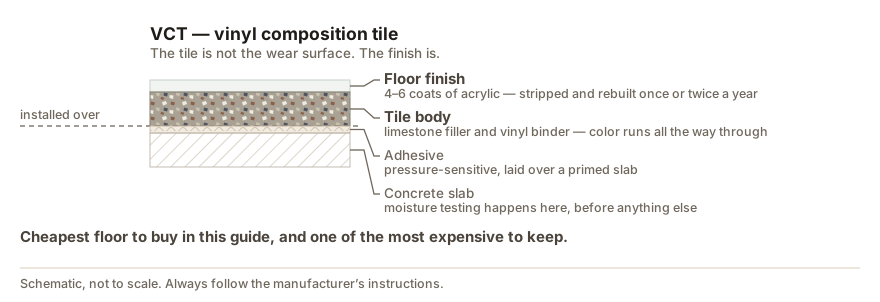
Inside VCT — Vinyl Composition Tile
The finish is the wear surface. That is the whole maintenance story.
VCT must carry 4–6 coats of acrylic finish. The finish, not the tile, is what you actually walk on and what gives VCT its shine.
Typical program: daily dust and damp mop, weekly-to-monthly burnish, strip and refinish 1–2× per year. Budget roughly $1.00–$2.00/sq ft/year in labor and materials.
Published analyses put VCT operational maintenance 22–27% above LVT or sheet vinyl, driven almost entirely by the labor and materials for finish application and removal. Worked as a model: a $3.50/sq ft VCT install carrying $1.50/sq ft/year lands near $18.50/sq ft over ten years, against roughly $9.50 for a $6.50/sq ft LVT floor maintained with a neutral cleaner. This is the core argument against VCT.
9"×9" tile and its black cutback adhesive installed before roughly 1980 may contain asbestos. Do not sand, grind or dry-scrape — test first and follow abatement rules.
VCT is glued down and is sensitive to slab RH. Elevated moisture causes adhesive re-emulsification and tile shifting.
The spec sheet
Key specifications
Size
12"×12" standard
Thickness
1/8" (3.2 mm)
Finish required
Yes — 4–6 coats
Annual upkeep
$1.00–$2.00/sq ft
Routine
Dust-mop daily, damp-mop with neutral cleaner
Burnish weekly to monthly depending on traffic
Spot-repair scuffs before they cut through finish
Periodic / deep
Strip all finish and reapply 4–6 coats 1–2× per year
Deep scrub and recoat as an interim, lower-cost alternative to full stripping
Never do this
Never let the finish wear through to bare tile — the tile itself will stain permanently
Never use high-pH strippers on adjacent surfaces without protection
Never disturb suspected asbestos-containing legacy tile
VCT is only the cheap option if you ignore labor. Run the ten-year number before specifying it — that comparison usually ends the conversation.
Each feature paired with the benefit it delivers. A spec on its own tells you nothing about
whether it is worth paying for.
01
Lowest material cost of any commercial floor
Puts a durable hard surface into a school corridor or stockroom on a capital budget that would not stretch to anything else.
02
Through-body color and pattern
Wear doesn’t reveal a different color underneath, and damaged tiles swap out individually from attic stock.
03
Twelve-inch modular format
Patterns, borders, colored insets and logos are all achievable with stock tile and a knife — design freedom at almost no material premium.
04
Repairable indefinitely
A gouged tile is a five-minute replacement. Fifty-year-old VCT floors are still in service because damage never accumulates.
05
Accepts a restorable finish
The floor you walk on is the wax, not the tile, so appearance is fully recoverable at any point — provided somebody is doing the recovering.
Before you buy
What to confirm on the quote
The specifications below decide how this floor performs. Ask for them in writing — a sample
board and a price per square foot do not tell you any of it.
Size: confirm it is 12"×12" standard
Thickness: confirm it is 1/8" (3.2 mm)
Finish required: confirm it is Yes — 4–6 coats
Annual upkeep: confirm it is $1.00–$2.00/sq ft
Substrate: ask what preparation is included and what is excluded
Warranty: ask what is covered after year one, and whether labor is included
Attic stock: order about 5% extra and keep it — replacements bought later rarely match
VCT — Vinyl Composition Tile runs $2.50–$6.00 per square foot installed in 2026 — $0.80 to $2.50 for material and $1.70 to $3.50 for professional labor. Spread across an expected 10 to 20 year service life that works out near $0.28 per square foot per year. Regional variation of 20 to 40% is normal, and demolition, subfloor prep and trim are extra.
10 to 20 years, assuming it went into an appropriate room over a properly prepared substrate and gets the maintenance it needs. VCT is only the cheap option if you ignore labor. Run the ten-year number before specifying it — that comparison usually ends the conversation.
Bedroom, Living / Family Room. Any project evaluated on 10-year total cost. Facilities without a maintenance program.
No. Standing water causes permanent damage. Wet areas and areas with standing water
Dust-mop daily, damp-mop with neutral cleaner. Burnish weekly to monthly depending on traffic. Critically: never let the finish wear through to bare tile — the tile itself will stain permanently.
Alternatives
Compare VCT — Vinyl Composition Tile with the alternatives
Same family first, then products with a similar look from other families.