Built-in stain resistance with resilience that closes most of the gap to nylon. Typical installed cost, durability,
where it works and how to care for it.
$4.00–$9.50 / sq ft installed8–18 year lifeHeavy trafficTextile
$4.00–$9.50per sq ft
8–18 yrlife
Heavytraffic
The basics
What is Triexta (PTT) Carpet?
Triexta carpet — also called PTT — is a carpet fiber that's chemically different from both nylon and polyester, even though it looks and feels similar to either one. It's spun and tufted into a backing the same way any carpet is made. Its main selling point is that stain resistance is built into the fiber itself, so it doesn't wear off the way a treatment sprayed onto other carpets eventually does.
Overview
A genuinely new fiber, not a rebrand of the old two
Triexta is PTT (polytrimethylene terephthalate), a polymer the FTC recognized as its own generic fiber category back in 2009 — a genuinely distinct chemistry from both nylon and polyester, not just a rebrand of either. Its whole pitch is closing the gap between those two older fibers: stain resistance that's built into the polymer rather than applied afterward, similar in principle to PET but effective against oil-based stains as well as water-based ones, paired with crush recovery that runs meaningfully closer to nylon than polyester ever managed.
Some triexta fiber also swaps a portion of its petroleum feedstock for plant-derived material. It generally costs more than PET and goes head-to-head with mid-to-premium nylon on price.
In real rooms
Triexta (PTT) carpet. A distinct polymer from nylon and polyester, with stain resistance built into the fiber rather than applied afterward, and crush recovery that runs closer to nylon than any polyester manages.
What it costs
Installed cost per square foot
Material / sq ft$2.50–$6.50
Install labor / sq ft$1.50–$3.00
Total installed / sq ft$4.00–$9.50
Expected life8–18 yr$0.52/yr
How it rates
Performance profile
Durability
Water resistance
Comfort underfoot
Sound absorption
Environmental profile
Ease of maintenance
Four separate scores
Living with pets
Claw resistance
Accidents
Traction
Hair & dirt
Cut pile with nylon-adjacent resilience, so claws don't pull it the way a loop construction does. The built-in stain resistance makes an accident easier to lift off the surface than on nylon, though the pad and subfloor beneath are exactly as exposed as they are under any other broadloom carpet.
Carpet's pile and pad insulate against the heat the system is generating. Workable with a thin, radiant-rated pad; not the first fiber to reach for over a hydronic system.
Stretched broadloom — tools run roughly $80–$180 to buy
A room in a day with the right tools. Same stretching rule as any broadloom carpet — the power stretcher is what keeps triexta's stain resistance from being undone by a rippled installation.
Stairs and hallways where polyester would not hold up
Households wanting stain resistance without nylon’s applied-treatment maintenance
Buyers who want a documented sustainability angle on synthetic carpet
Where to think twice
Extreme commercial traffic where nylon still leads
Budget projects where standard PET covers the need
Rooms with heavy oil-based soiling where any fiber needs frequent attention
Advertisement
How it is built
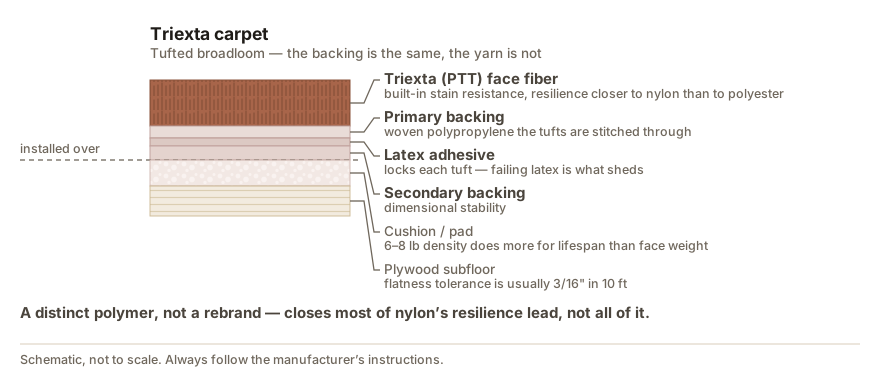
Inside Triexta (PTT) Carpet
A separate polymer from nylon and polyester, not a variant of either.
PTT sits chemically and functionally between the other two: better crush recovery than PET, built-in rather than applied stain resistance like PET, and traffic-lane performance that narrows nylon’s lead without fully erasing it. Independent testing is more consistent on the stain-resistance claim than on the resilience claim, so treat "closes most of the gap" as the honest version rather than "matches nylon."
Nylon’s stain protection is a topical treatment applied after tufting, and it diminishes with repeated hot-water extraction. Triexta’s resistance is a property of the polymer itself, so it doesn’t wash out or wear off on the same schedule — which is what backs the unusually broad stain warranties some products carry.
Not all triexta uses renewable feedstock in the same proportion, and some competing fibers make similar claims with different substantiation. Ask for the specific renewable-content percentage rather than accepting "eco-friendly" as a self-explanatory label.
Nylon retains the edge in extreme commercial and institutional traffic, and most triexta marketing and warranty structures are built around residential use. That doesn’t make it commercial-grade for extreme applications, whatever an individual product’s face weight suggests.
The spec sheet
Key specifications
Typical face weight
35–55 oz/yd²
Warranty range
10–25 yrs, often with a broad stain warranty
FTC generic name
Triexta, recognized 2009
Feedstock
Petroleum, often partly plant-derived
Routine
Vacuum weekly with a beater bar; the fiber tolerates it better than ultra-soft PET does
Blot spills — the built-in resistance buys time, it doesn’t make a spill invisible or permanent-proof
Rotate furniture periodically the same as any cut-pile carpet
Periodic / deep
Hot water extraction every 12–18 months, same interval as nylon
No need for the reduced-moisture caution PET sometimes requires, since the fiber doesn’t hold residue the same way
Never do this
Never assume "stain-resistant" means stain-proof — prompt blotting still matters
Never use a topical stain treatment on top of it; the built-in protection doesn’t need reinforcing and some additives can interfere with it
Never install it expecting nylon-level performance in an extreme-traffic commercial corridor
The realistic pitch is "most of nylon’s resilience, none of nylon’s reapplied stain treatment" — not "identical to nylon." Judged on that basis, it’s usually worth the premium over plain polyester.
Each feature paired with the benefit it delivers. A spec on its own tells you nothing about
whether it is worth paying for.
01
Stain resistance built into the polymer
Unlike nylon's applied topical treatment, which wears down with repeated cleaning, triexta's resistance to both oil- and water-based stains is part of the fiber itself and doesn’t diminish over the life of the carpet.
02
Resilience closer to nylon than to polyester
The molecular structure recovers from crushing meaningfully better than PET does, closing much of the gap that has historically separated budget synthetics from nylon in traffic lanes.
03
Often partly plant-based
Some triexta fiber replaces a portion of its petroleum feedstock with renewable, plant-derived material, a genuine and verifiable sustainability claim rather than a marketing gesture.
04
FTC-recognized as its own fiber generic, not a marketing name
The US Federal Trade Commission added triexta as a distinct generic fiber category in 2009. It is a real polymer family (PTT), not a brand name for polyester with a new label.
05
Strong manufacturer stain warranties
Because the protection is inherent rather than applied, several triexta products carry stain warranties that are unusually broad by carpet-industry standards.
Before you buy
What to confirm on the quote
The specifications below decide how this floor performs. Ask for them in writing — a sample
board and a price per square foot do not tell you any of it.
Typical face weight: confirm it is 35–55 oz/yd²
Warranty range: confirm it is 10–25 yrs, often with a broad stain warranty
FTC generic name: confirm it is Triexta, recognized 2009
Feedstock: confirm it is Petroleum, often partly plant-derived
Substrate: ask what preparation is included and what is excluded
Warranty: ask what is covered after year one, and whether labor is included
Attic stock: order about 5% extra and keep it — replacements bought later rarely match
Triexta (PTT) Carpet runs $4.00–$9.50 per square foot installed in 2026 — $2.50 to $6.50 for material and $1.50 to $3.00 for professional labor. Spread across an expected 8 to 18 year service life that works out near $0.52 per square foot per year. Regional variation of 20 to 40% is normal, and demolition, subfloor prep and trim are extra.
8 to 18 years, assuming it went into an appropriate room over a properly prepared substrate and gets the maintenance it needs. The realistic pitch is "most of nylon’s resilience, none of nylon’s reapplied stain treatment" — not "identical to nylon." Judged on that basis, it’s usually worth the premium over plain polyester.
No. Standing water causes permanent damage. Keep it out of wet areas.
Vacuum weekly with a beater bar; the fiber tolerates it better than ultra-soft PET does. Blot spills — the built-in resistance buys time, it doesn’t make a spill invisible or permanent-proof. Critically: never assume "stain-resistant" means stain-proof — prompt blotting still matters.
Alternatives
Compare Triexta (PTT) Carpet with the alternatives
Same family first, then products with a similar look from other families.