The slab you already own, ground and densified into a finish floor. Typical installed cost, durability,
where it works and how to care for it.
$4.00–$12.00 / sq ft installed50–100 year lifeExtreme trafficCommercial ratedConcrete look
$4.00–$12.00per sq ft
50–100 yrlife
Extremetraffic
The basics
What is Polished Concrete?
Polished concrete is just what it says — the concrete slab already under most buildings, ground smooth with progressively finer diamond discs and treated with a chemical hardener until it shines. There's no separate flooring material laid on top; the floor is the same slab the building sits on. That makes it cheap on materials, but entirely dependent on the skill of whoever grinds and polishes it.
Overview
Barely any material cost — the skill is the whole price
Polished concrete turns your existing structural slab into the finished surface itself — ground with progressively finer diamond abrasives and treated with a chemical densifier that reacts with free lime to harden the surface. There's almost no material to buy, which is why nearly the whole price is labor, and why the result depends entirely on the operator's skill.
There's no coating to peel, no seams, and nothing to replace. Appearance comes down to how deep the grind goes: a cream finish exposes almost no aggregate, a salt-and-pepper finish exposes fine sand, and a full aggregate exposure reveals the stone underneath.
It's cold, hard, loud, and unforgiving of a dropped glass — and nearly indestructible.
In real rooms
Polished concrete. Not a coating — this is the structural slab itself, ground through progressively finer diamond grits until it reflects. There is almost no material to buy, which is why nearly the whole price is labor and why the result depends entirely on the operator.
What it costs
Installed cost per square foot
Material / sq ft$0.00–$2.00
Install labor / sq ft$4.00–$10.00
Total installed / sq ft$4.00–$12.00
Expected life50–100 yr$0.11/yr
How it rates
Performance profile
Durability
Water resistance
Comfort underfoot
Sound absorption
Environmental profile
Ease of maintenance
Four separate scores
Living with pets
Claw resistance
Accidents
Traction
Hair & dirt
Claws do nothing to it. Accidents are a different story — concrete is porous, and unless it's properly densified and sealed, urine soaks in and the smell stays. Saw-cut control joints are a trap for the same reason. Slippery when polished.
Often the radiant source itself: hydronic tubing is routinely embedded directly in the slab before it's ground and polished, which is about as efficient as this pairing gets.
Slabs with extensive cracking or prior adhesive contamination
Spaces where comfort and warmth matter
Upper floors over wood framing
Environments needing acoustic absorption
Advertisement
How it is built
Inside Polished Concrete
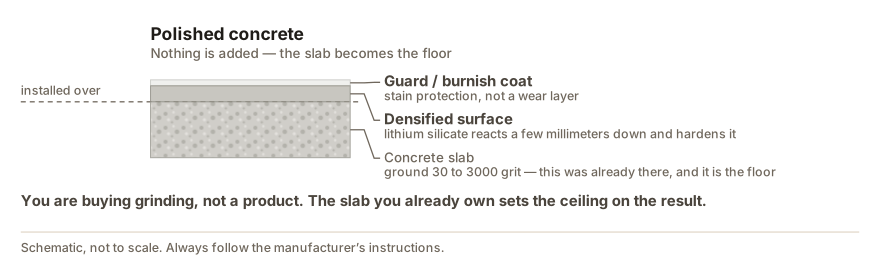
Nothing is added. The slab you already have is the floor you get.
Lithium, sodium or potassium silicate penetrates the slab and reacts with calcium hydroxide to form additional binder, hardening the surface and reducing dusting.
Measured 1–4 (or by grit sequence). Level 1 is a flat matte ground finish; Level 4 is a mirror polish requiring grits up to 3000. Higher gloss means more labor and higher cost.
Cream (no exposure), salt-and-pepper (fine), and full aggregate. Deeper exposure means removing more material — more passes, higher cost, and it reveals whatever the pour actually contains.
Old adhesive, patches, saw cuts, spalling and prior coatings all show. Grinding reveals history — it doesn't erase it. Always test-grind a small area first.
Acid stains react chemically for variegated, mottled color. Water-based dyes give consistent, vivid color but less UV stability. Both are applied mid-process.
Control joints are filled with semi-rigid polyurea to support edges under traffic — skipping this causes joint spalling under forklift and cart wheels.
The lowest-cost floor in a new build is often the slab you were already paying for. But the polish quality is capped by the quality of the pour — coordinate with the concrete contractor before the slab goes down.
Each feature paired with the benefit it delivers. A spec on its own tells you nothing about
whether it is worth paying for.
01
Uses the slab you already own
In new build the structural slab becomes the finished floor. The lowest-cost floor in the building is often the one you were already paying for.
02
Chemical densification
Silicate reacts with free lime to harden the surface from within, reducing dusting and raising abrasion resistance without adding a coating.
03
No coating to fail
Nothing to peel, blister or delaminate, because the finish is mechanical. Forklift traffic doesn’t lift it.
04
Renewable finish
Burnishing restores gloss and a full regrind resets the floor entirely, indefinitely.
05
Choice of aggregate exposure
Cream, salt-and-pepper or full stone exposure from the same slab, so the look is set by how deep you grind rather than what you buy.
Before you buy
What to confirm on the quote
The specifications below decide how this floor performs. Ask for them in writing — a sample
board and a price per square foot do not tell you any of it.
Gloss levels: confirm it is 1 (matte) – 4 (mirror)
Exposure: confirm it is Cream, salt-and-pepper, full
Coating: confirm it is None — mechanical polish
Renewable: confirm it is Yes, indefinitely
Substrate: ask what preparation is included and what is excluded
Warranty: ask what is covered after year one, and whether labor is included
Attic stock: order about 5% extra and keep it — replacements bought later rarely match
Polished Concrete runs $4.00–$12.00 per square foot installed in 2026 — $0.00 to $2.00 for material and $4.00 to $10.00 for professional labor. Spread across an expected 50 to 100 year service life that works out near $0.11 per square foot per year. Regional variation of 20 to 40% is normal, and demolition, subfloor prep and trim are extra.
50 to 100 years, assuming it went into an appropriate room over a properly prepared substrate and gets the maintenance it needs. The lowest-cost floor in a new build is often the slab you were already paying for. But the polish quality is capped by the quality of the pour — coordinate with the concrete contractor before the slab goes down.
Basement (below grade), Home Gym, Garage / Workshop. Warehouses, retail, breweries, showrooms. Modern residential and loft conversions.
Bedroom. Slabs with extensive cracking or prior adhesive contamination. Spaces where comfort and warmth matter.
It tolerates water well but has a vulnerability, usually at the seams or the backing. Fine for splashes, not for standing water without care.
Dust-mop daily to remove abrasive grit. Auto-scrub or damp-mop with a pH-neutral cleaner. Critically: never use acidic cleaners — they attack the cement matrix.
Alternatives
Compare Polished Concrete with the alternatives
Same family first, then products with a similar look from other families.