The original LVP: thin, glued down, repairable, and unforgiving of a bad subfloor. Typical installed cost, durability,
where it works and how to care for it.
$3.50–$9.00 / sq ft installed10–20 year lifeExtreme trafficCommercial ratedWood-look, Stone & marble
$3.50–$9.00per sq ft
10–20 yrlife
Extremetraffic
The basics
What is Luxury Vinyl Plank — Flexible (Glue-Down)?
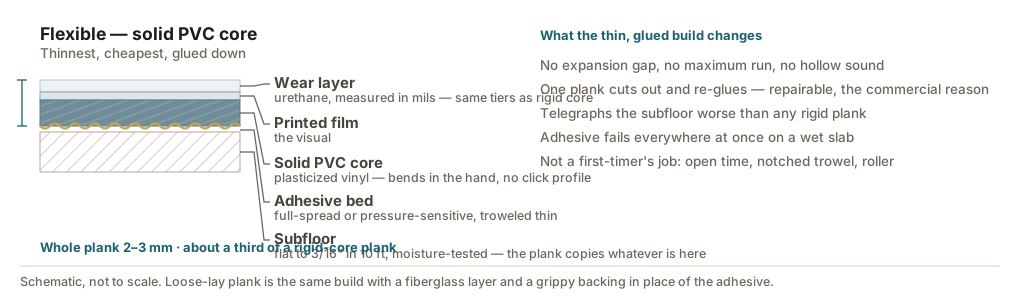
Flexible luxury vinyl plank — also sold as dryback or glue-down LVP — is the vinyl plank that came before rigid core: a printed wood or stone design under a clear wear layer, on a solid plasticized PVC body about two to three millimeters thick. It bends in your hands, it has no click joint, and it is glued to the subfloor with a troweled adhesive. It is the standard vinyl plank in retail, offices and healthcare, and the entry price for a vinyl plank floor at home.
Overview
Thin, glued and repairable — and it shows you every ridge underneath
All three luxury vinyl plank cores are PVC. What separates flexible plank from SPC and WPC is that nothing is mixed into it: no limestone powder to stiffen it, no foaming agent to thicken it. The result is a plank a third the thickness of a rigid one that cannot hold a click joint, so it is fixed to the floor with a full-spread or pressure-sensitive adhesive instead. Glued down, it does not expand and contract as one sheet, which removes every rule that governs a floating floor — no expansion gap, no maximum run before a transition, no hollow sound, no gapping when an island pins it.
The same thinness is the trade. A flexible plank conforms to whatever it is laid over, so trowel ridges, plywood joints and old adhesive patterns show through in raking light unless the subfloor is skim-coated flat first, and the adhesive is what fails on a slab that was never moisture-tested. It is a professional installation for those reasons rather than any difficulty in the planks themselves. A loose-lay variant adds a fiberglass layer and a grippy backing so it lies flat without adhesive or joints, for rooms that will be refloored again.
In real rooms
Flexible glue-down vinyl plank in a commercial corridor. A third the thickness of a rigid plank and glued straight to the slab, so it runs the whole length with no transition and lies dead flat — and the slab under it had to be skim-coated first, because a plank this thin shows every ridge.
What it costs
Installed cost per square foot
Material / sq ft$1.50–$4.50
Install labor / sq ft$2.00–$4.50
Total installed / sq ft$3.50–$9.00
Expected life10–20 yr$0.42/yr
How it rates
Performance profile
Durability
Water resistance
Comfort underfoot
Sound absorption
Environmental profile
Ease of maintenance
Four separate scores
Living with pets
Claw resistance
Accidents
Traction
Hair & dirt
Same surface and wear-layer rules as rigid core, so it takes claws the same way at the same mil rating. Glued down there are fewer places for an accident to travel than under a floating floor, and one ruined plank swaps out without lifting the room.
Thin and glued directly to the slab, so it passes heat through readily. The limit is the adhesive: confirm it is rated for radiant use and keep the surface under the manufacturer's cap, typically 80–85°F. Manufacturer surface-temperature limit: about 85°F.
Glue-down; loose-lay for the DIY version — tools run roughly $100–$250 to buy
A room in a weekend for a professional; longer for a first-timer, limited by adhesive open time. The planks are the easy part. Skim-coating the subfloor flat, troweling adhesive at the right notch and rolling the floor before it sets are the parts a first attempt gets wrong. Loose-lay plank removes all three.
Where Luxury Vinyl Plank — Flexible (Glue-Down) works well
Retail, offices, healthcare and anywhere a floor is repaired rather than replaced
Open plans with long runs and no place for a transition
Budget rooms over a flat, sound slab or skim-coated subfloor
Rentals where a damaged plank should be a ten-minute fix
Where to think twice
Any subfloor that is not flat and skim-coated — it will telegraph
Slabs that have not been moisture-tested
Do-it-yourself installations, unless it is the loose-lay variant
Rooms where a thicker, warmer, quieter floor matters
Advertisement
How it is built
Inside Luxury Vinyl Plank — Flexible (Glue-Down)
A third the thickness of a rigid plank and glued rather than clicked. The subfloor under it is part of the floor.Wear layer resists abrasion. Denting is a property of the core.
Same wear layer, same printed film, same waterproof PVC chemistry. Flexible plank has nothing mixed into the core, so it is thin and bends; SPC is stiffened with limestone, WPC is thickened with foam. Rigid cores click together and float; flexible plank is glued.
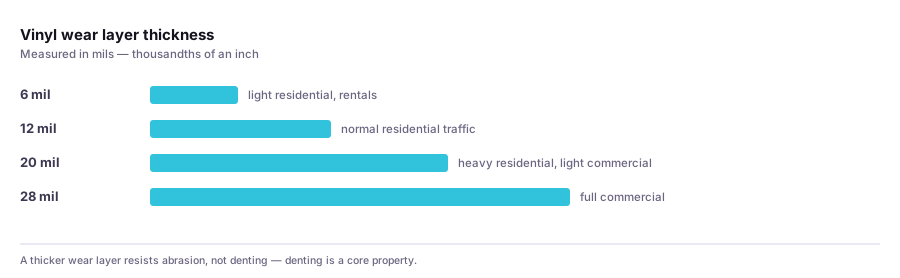
Identical tiers to rigid core: 6 mil light residential, 12 mil family home, 20 mil commercial and dogs, 28 mil heavy commercial. Commercial dryback is where 20 and 28 mil products are most common.
Full-spread is troweled wet and the plank is set into it — permanent, strongest, and the one that fails on a wet slab. Pressure-sensitive adhesive is left to tack up first and stays slightly releasable, which is what makes single-plank repair practical.
A heavier flexible plank, usually 4–5 mm, with a fiberglass reinforcement layer and a friction backing. Lies flat under its own weight and stays put with perimeter adhesive or grip strip, so it comes up again cleanly. The DIY-friendly member of the family.
Thin and glued to a hard base, so a point load has nowhere to go but into the plank. Ask for the static-load or residual-indentation figure; commercial product is tested for it and residential product often is not.
As for rigid core: reputable current product is phthalate-free and FloorScore certified. Imported dryback is where the exceptions are most often found — ask for the certificate.
The spec sheet
Key specifications
Wear layer
6–28 mil
Total thickness
2–3 mm (loose-lay 4–5 mm)
Waterproof
Yes — the plank; the adhesive is not
Install
Glue-down (full-spread or pressure-sensitive); loose-lay variant
Routine
Sweep or vacuum (beater bar off) regularly
Damp-mop with a pH-neutral vinyl cleaner — the plank is waterproof
Felt pads under furniture; wide non-marking casters on rolling chairs
Walk-off mats at doors to trap abrasive grit
Periodic / deep
Replace a damaged plank: cut out, scrape the adhesive, glue in a new one
Use a manufacturer-approved scuff remover for black heel marks
Never wax — the wear layer is a factory finish with nothing for wax to bond to
Never do this
Never flood-mop — standing water finds the perimeter and the adhesive
Never use rubber-backed mats — vinyl reacts with rubber and stains permanently
Never use abrasive pads, bleach, or "mop and shine" products
Flexible plank makes sense where a floor gets repaired rather than replaced, or where the budget is the point. The money you save on the plank should go into the subfloor, or you will see every ridge for the life of the floor.
Each feature paired with the benefit it delivers. A spec on its own tells you nothing about
whether it is worth paying for.
01
Solid PVC core, two to three millimeters thick
The original luxury vinyl plank, from before rigid core existed. Plasticized vinyl that bends in the hand, with no click profile — it is glued to the floor instead.
02
No expansion gap, no maximum run, no transitions
A glued floor does not move as a raft, so the rules that govern floating plank — gaps at every wall, a break before the stated run — do not apply. It runs wall to wall through an open plan.
03
Repairable one plank at a time
A damaged plank is cut out, the adhesive scraped, a new plank glued in. That is why commercial buyers specify it: a retail aisle does not close for a floor repair.
04
Same wear-layer tiers as rigid core
Six to 28 mil, and the same rules: 12 mil for a family home, 20 mil for dogs or commercial. The core does not decide how the surface ages; the wear layer does.
05
The cheapest plank to buy
Less material than a rigid plank and no locking edge to mill. The saving is real, and a share of it goes straight back into subfloor preparation, because the plank copies whatever is under it.
Before you buy
What to confirm on the quote
The specifications below decide how this floor performs. Ask for them in writing — a sample
board and a price per square foot do not tell you any of it.
Wear layer: confirm it is 6–28 mil
Total thickness: confirm it is 2–3 mm (loose-lay 4–5 mm)
Waterproof: confirm it is Yes — the plank; the adhesive is not
Install: confirm it is Glue-down (full-spread or pressure-sensitive); loose-lay variant
Substrate: ask what preparation is included and what is excluded
Warranty: ask what is covered after year one, and whether labor is included
Attic stock: order about 5% extra and keep it — replacements bought later rarely match
Luxury Vinyl Plank — Flexible (Glue-Down) runs $3.50–$9.00 per square foot installed in 2026 — $1.50 to $4.50 for material and $2.00 to $4.50 for professional labor. Spread across an expected 10 to 20 year service life that works out near $0.42 per square foot per year. Regional variation of 20 to 40% is normal, and demolition, subfloor prep and trim are extra.
10 to 20 years, assuming it went into an appropriate room over a properly prepared substrate and gets the maintenance it needs. Flexible plank makes sense where a floor gets repaired rather than replaced, or where the budget is the point. The money you save on the plank should go into the subfloor, or you will see every ridge for the life of the floor.
Yes — flexible vinyl plank is unaffected by water, which is why it works in bathrooms, laundries and below grade. Note that a waterproof material does not make a waterproof floor: water can still travel through seams to the subfloor beneath.
Sweep or vacuum (beater bar off) regularly. Damp-mop with a pH-neutral vinyl cleaner — the plank is waterproof. Critically: never flood-mop — standing water finds the perimeter and the adhesive.
Alternatives
Compare Luxury Vinyl Plank — Flexible (Glue-Down) with the alternatives
Same family first, then products with a similar look from other families.