In cross-section
How they are built
For a house, rigid core, almost every time: it floats over a subfloor that is merely sound rather than perfect, a first-timer can lay it, and it is thicker, warmer and quieter underfoot. Flexible plank wins where a floor is repaired rather than replaced — retail, offices, healthcare, rentals — and where the budget genuinely is the point and the slab is flat. The trap is buying flexible plank for the price and then discovering that the money saved was the money the subfloor needed.
Installed cost includes material and professional labor. Ratings are relative across all 21 materials on this site, not absolute scores.
| Luxury Vinyl Plank — Flexible (Glue-Down) | Luxury Vinyl Plank — SPC (Rigid Core) | |
|---|---|---|
| Installed cost per sq ft | $3.50–$9.00 | $4.00–$11.00 |
| Expected service life | 10–20 years | 15–25 years |
| Cost per sq ft per year | $0.42 | $0.38 |
| Durability | 3/5 | 4/5 |
| Water resistance | 5/5 | 5/5 |
| Comfort underfoot | 2/5 | 2/5 |
| Sound absorption | 2/5 | 3/5 |
| Ease of maintenance | 5/5 | 5/5 |
| DIY friendliness | 2/5 | 5/5 |
| Environmental profile | 2/5 | 2/5 |
| Traffic rating | Extreme | Extreme |
| Commercially rated | Yes | Yes |
The points that decide this in practice — not the spec sheet items that read well but rarely change anyone's mind.
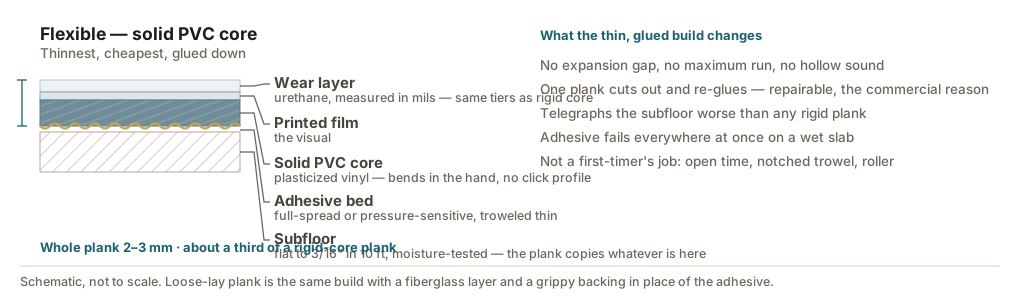
Flexible plank is plasticized vinyl with nothing mixed in: two to three millimeters thick, bends in the hand, no click joint. SPC is the same vinyl loaded with limestone powder until it is rigid enough to hold a milled click profile, four to eight millimeters thick with a pad underneath. The wear layer over both is the same film in the same mil tiers, which is why the surface ages the same way at the same rating.
A glued floor has no expansion gap to keep, no maximum run before a transition, no hollow sound and nothing to gap when an island pins it. A floating floor has all four rules, and breaking any of them is the most common LVP failure on the site. In exchange, the floating floor can be laid over a subfloor that is merely sound, and lifted again.
A thin, flexible plank conforms to whatever is under it: trowel ridges, plywood joints, old adhesive patterns, all visible in raking light. The flatness tolerance of 3/16 inch in 10 feet is a minimum, and most flexible installations need a skim coat first. A rigid plank bridges more of that. Neither fixes it.
A damaged flexible plank is cut out, the adhesive scraped, and a new plank glued in — a ten-minute job that does not disturb its neighbors, which is why commercial floors are specified this way. A floating floor comes apart from the nearest wall, so a plank in the middle of a room means lifting everything between it and that wall.
Rigid click plank is the one floor most people can install themselves; the tool kit is a tapping block, a pull bar and spacers. Flexible plank is a professional job: skim-coating, adhesive open time, notched-trowel technique and rolling the floor before the adhesive sets are where a first attempt goes wrong. The exception is loose-lay flexible plank, which needs neither adhesive nor joints.
$3.50–$9.00 per sq ft installed, lasting 10–20 years — about $0.42 per sq ft per year.
Flexible plank makes sense where a floor gets repaired rather than replaced, or where the budget is the point. The money you save on the plank should go into the subfloor, or you will see every ridge for the life of the floor.
$4.00–$11.00 per sq ft installed, lasting 15–25 years — about $0.38 per sq ft per year.
Wear layer is the whole ballgame. 12 mil minimum for a family home, 20 mil for anything commercial. Below 8 mil is a rental-grade product.
The plank is — solid PVC does not absorb water. The assembly is only as waterproof as the adhesive, which is why a slab has to be moisture-tested to ASTM F2170 before a glue-down floor goes over it. On a dry slab, a glued floor actually has fewer paths for water to reach the subfloor than a floating one, because there is no gap at the perimeter.
To buy, yes — roughly a dollar to two per square foot less for the plank, because there is less material in it and no locking edge to mill. Installed, the gap narrows or disappears: glue-down labor costs more than click, and the subfloor preparation a flexible plank needs is a line item a floating floor often skips.
Glue-down, not really — the planks are the easy part, and the adhesive is where it goes wrong. Loose-lay flexible plank is the DIY version: a heavier plank with a fiberglass layer and a friction backing that lies flat under its own weight and is held at the perimeter. If a flexible floor appeals for its thinness or its repairability, loose-lay is the way to get it without a contractor.
Buy LVP if the room will ever see standing water — unless the laminate you're looking at is the sealed-core tier with a…
Engineered hardwood is real wood that can be refinished and adds resale value. LVP is waterproof, cheaper and more…
Solid hardwood can be refinished five to eight times across a lifetime and carries the strongest resale premium in…
This is usually a room-by-room decision, not a whole-house one. LVP wins on cleaning, water, pets and resale. Carpet…
SPC is denser and harder, so it dents less but hides subfloor flaws worse. WPC is thicker and softer, so it feels warmer…
Sheet vinyl is the more genuinely waterproof installation, because it has almost no seams. LVP looks far better, repairs…