Seamless chemical- and impact-resistant coating systems. Typical installed cost, durability,
where it works and how to care for it.
$3.50–$18.00 / sq ft installed10–25 year lifeExtreme trafficCommercial ratedSolid & pattern, Concrete look
$3.50–$18.00per sq ft
10–25 yrlife
Extremetraffic
The basics
What is Epoxy & Resinous Coatings?
Epoxy flooring is a liquid plastic coating that gets rolled or troweled onto a concrete floor, where it cures into one seamless, hard, glossy layer — like a very tough coat of paint. It goes on wet and hardens in place, with no seams or joints anywhere once it's done. That seamless, chemical-resistant surface is why you'll see it in garages, workshops and commercial kitchens.
Overview
The system is only as good as the prep underneath it
Resinous flooring is a family of liquid-applied systems — epoxy, polyaspartic, polyurethane, MMA and urethane cement — troweled or rolled over prepared concrete, where it cures into one continuous, seamless, impermeable membrane with no grout lines or seams anywhere. That's exactly why it's standard in commercial kitchens and labs.
Which system gets specified comes down to the chemical and thermal exposure of the space: a garage needs a different system than a dairy processing floor that gets steam-cleaned at 180 °F. At home it's unforgiving in a different way — the material cures on a clock, and the finish gets decided in the pour, not corrected afterward.
The universal truth across all of them: 80% of failures trace back to surface preparation, not the product. Diamond grinding or shot blasting to a proper concrete surface profile is non-negotiable.
In real rooms
Resinous epoxy flooring, here as a decorative metallic pour. It goes down as a liquid and cures into one continuous sheet with no grout lines and no seams anywhere — the same property that makes it standard in commercial kitchens and labs. Residentially it is unforgiving: the material cures on a clock, and the finish you get is decided in the pour rather than corrected afterwards.
What it costs
Installed cost per square foot
Material / sq ft$1.50–$6.00
Install labor / sq ft$2.00–$12.00
Total installed / sq ft$3.50–$18.00
Expected life10–25 yr$0.61/yr
How it rates
Performance profile
Durability
Water resistance
Comfort underfoot
Sound absorption
Environmental profile
Ease of maintenance
Four separate scores
Living with pets
Claw resistance
Accidents
Traction
Hair & dirt
Seamless and chemically resistant, with an integral cove available, so accidents have nowhere to go. Traction depends entirely on the finish: a broadcast quartz or flake system grips well, while a smooth high-gloss pour is as slick as polished stone.
Compatible over a slab with embedded tubing, but rapid or excessive temperature swings are a known cause of epoxy cracking and delamination. Ramp the system up gradually rather than all at once.
Roll-on kit, with real limits — tools run roughly $80–$200 to buy
A weekend, including cure time between coats. A rolled-on kit over acid-etched concrete is attemptable and often peels within a season — surface prep is nearly the whole job. The broadcast quartz or flake systems professionals use need equipment a DIY kit doesn't include.
Spaces with heavy UV exposure (standard epoxy ambers)
Anywhere the substrate can’t be mechanically prepped
Advertisement
How it is built
Inside Epoxy & Resinous Coatings
The bond line at the slab decides everything above it.
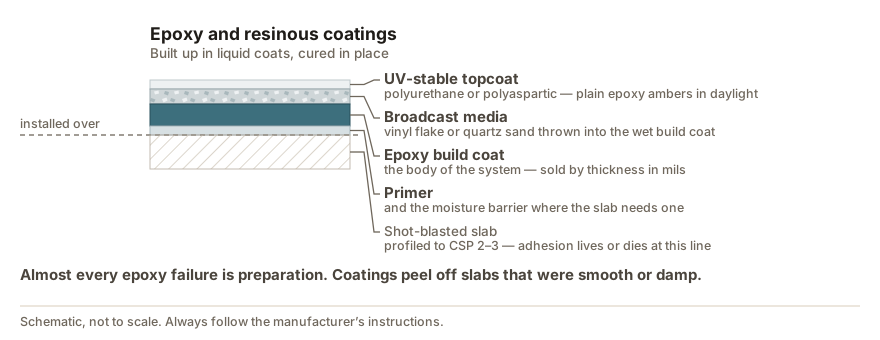
Diamond grinding or shot blasting to the profile the manufacturer specifies, per ICRI Technical Guideline 310.2R. Thin sealers and low-build coatings bond at CSP 1–2; high-build epoxy and urethane systems typically need CSP 3–5; thick polymer overlays and cementitious toppings need CSP 6 or higher. Acid etching doesn't achieve these profiles and is the leading cause of delamination. Deviating from the stated range voids the warranty on most products.
Epoxy: best adhesion and build, ambers in UV. Polyaspartic: cures in hours, UV-stable, thin. Urethane cement: survives thermal shock and steam cleaning — the food-plant standard. MMA: cures below freezing, strong odor.
Concrete slabs release vapor. ASTM F1869 caps moisture vapor emission at 3 lbs/1,000 sq ft/24 hr and ASTM F2170 caps in-slab relative humidity at 75% unless the flooring or adhesive manufacturer states otherwise — some products are warranted to 80–85%. Above the stated limit a moisture-mitigation primer is required or the coating will blister off.
Vinyl flake or quartz aggregate broadcast into the wet base coat then sealed. Adds slip resistance, hides substrate imperfections and dramatically increases wear life over a plain roll-on coat.
A big-box DIY kit is 3–5 mils. A professional garage system is 20–40 mils. An industrial mortar system is 1/4". These are different products despite sharing the word "epoxy."
Smooth epoxy is dangerously slick when wet. Aluminum-oxide or aggregate broadcast is required anywhere water, oil or grease occurs.
The spec sheet
Key specifications
Thickness
3 mils (DIY) – 1/4" (industrial)
Cure time
12 hrs – 7 days by system
Chemical resistance
System-specific chart
Seamless
Yes
Routine
Sweep or dust-mop; auto-scrub in commercial settings
Clean with a neutral cleaner; rinse thoroughly
Address chemical spills per the system's chemical-resistance chart
Periodic / deep
Recoat the topcoat every 5–10 years to extend the base system indefinitely
Spot-repair chips promptly before moisture undercuts adhesion
Never do this
Never use citrus or solvent cleaners on standard epoxy
Never park hot tires on a thin DIY coating — hot tire pickup lifts it
Never apply over a slab that hasn’t been moisture tested and mechanically profiled
Ask for the mil thickness and the prep method in writing. Two quotes that both say "epoxy garage floor" can differ by 10× in service life.
Each feature paired with the benefit it delivers. A spec on its own tells you nothing about
whether it is worth paying for.
01
Liquid-applied and seamless
Flows into a continuous membrane with no joints, then coves up the wall — the reason it is standard in food processing and pharmaceutical plants.
02
System matched to the exposure
Epoxy, polyaspartic, urethane cement and MMA each solve a different problem, from UV stability to surviving 180°F washdown.
03
Broadcast quartz or vinyl flake
Aggregate cast into the wet coat adds slip resistance, hides substrate imperfection and multiplies wear life over a plain roll-on coat.
04
Documented chemical resistance
Published charts tell you exactly what the floor survives, so specification is a matching exercise rather than a hope.
05
Renewable topcoat
Recoating the wear layer every five to ten years extends the base system indefinitely without removing anything.
Before you buy
What to confirm on the quote
The specifications below decide how this floor performs. Ask for them in writing — a sample
board and a price per square foot do not tell you any of it.
Thickness: confirm it is 3 mils (DIY) – 1/4" (industrial)
Cure time: confirm it is 12 hrs – 7 days by system
Chemical resistance: confirm it is System-specific chart
Seamless: confirm it is Yes
Substrate: ask what preparation is included and what is excluded
Warranty: ask what is covered after year one, and whether labor is included
Attic stock: order about 5% extra and keep it — replacements bought later rarely match
Epoxy & Resinous Coatings runs $3.50–$18.00 per square foot installed in 2026 — $1.50 to $6.00 for material and $2.00 to $12.00 for professional labor. Spread across an expected 10 to 25 year service life that works out near $0.61 per square foot per year. Regional variation of 20 to 40% is normal, and demolition, subfloor prep and trim are extra.
10 to 25 years, assuming it went into an appropriate room over a properly prepared substrate and gets the maintenance it needs. Ask for the mil thickness and the prep method in writing. Two quotes that both say "epoxy garage floor" can differ by 10× in service life.
Home Gym, Garage / Workshop. Garages, workshops, warehouses. Commercial kitchens and food processing.
Yes — epoxy coating is unaffected by water, which is why it works in bathrooms, laundries and below grade. Note that a waterproof material does not make a waterproof floor: water can still travel through seams to the subfloor beneath.
Sweep or dust-mop; auto-scrub in commercial settings. Clean with a neutral cleaner; rinse thoroughly. Critically: never use citrus or solvent cleaners on standard epoxy.
Alternatives
Compare Epoxy & Resinous Coatings with the alternatives
Same family first, then products with a similar look from other families.