Poured aggregate composite — the 75-year institutional floor. Typical installed cost, durability,
where it works and how to care for it.
$20.00–$50.00 / sq ft installed40–100 year lifeExtreme trafficCommercial ratedSolid & pattern, Concrete look
$20.00–$50.00per sq ft
40–100 yrlife
Extremetraffic
The basics
What is Terrazzo?
Terrazzo is a floor made by pouring a mix of marble, glass or stone chips suspended in a binder, letting it cure, then grinding and polishing it smooth — like speckled polished concrete, but with real decorative stone or glass mixed in. Because it's poured as one continuous layer, there are no seams anywhere. It's expensive to install, but it can be reground like new decades later — which is why airports and old schools still have the terrazzo they were built with.
Overview
No seams to fail, and no tolerance for a bad pour
Terrazzo is marble, granite, glass or shell chips suspended in a binder, poured in place, cured, then ground and polished to a mirror surface with no seams anywhere in the field — and because none of it can be replaced in pieces, it's also the floor on this site with the least tolerance for a bad installation.
Epoxy terrazzo is the modern standard: thin (3/8"), lightweight, seamless, available in unlimited colors, and pourable into complex logos and patterns with metal divider strips. NTMA guide specifications set nominal epoxy terrazzo thickness at 3/8 inch.
Its installed cost is among the highest of any flooring, and its lifecycle cost is among the lowest — the longest-lived floor on this site, which is exactly why airports and universities specify it: a decades-old terrazzo floor can simply be reground to look new again.
In real rooms
Terrazzo. Chips of marble, granite or glass suspended in a binder, poured in place and then ground flat, so there are no seams anywhere in the field. It is the longest-lived floor on this site and the one with the least tolerance for a bad installation, because none of it is replaceable in pieces.
What it costs
Installed cost per square foot
Material / sq ft$10.00–$25.00
Install labor / sq ft$10.00–$25.00
Total installed / sq ft$20.00–$50.00
Expected life40–100 yr$0.50/yr
How it rates
Performance profile
Durability
Water resistance
Comfort underfoot
Sound absorption
Environmental profile
Ease of maintenance
Four separate scores
Living with pets
Claw resistance
Accidents
Traction
Hair & dirt
Effectively indestructible and, in epoxy terrazzo, genuinely seamless — no grout, nothing for urine to get into. The only real objection is traction: it's polished by definition, so runners in the circulation routes aren't optional with a large or elderly dog.
Cementitious and dense, with the thermal mass to hold and even out a radiant system's output — a traditional pairing in the same way tile and stone are.
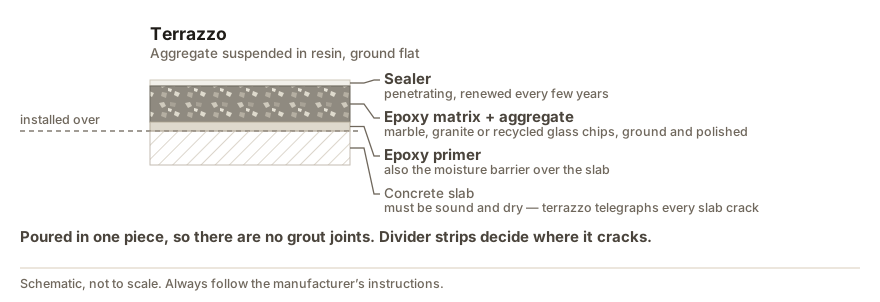
Poured as one piece. No grout joints anywhere in it.
Epoxy terrazzo is thin, non-porous, chemical-resistant and interior-only. Cementitious terrazzo is thicker, heavier, breathable and the only option for exterior and over-slab-on-grade with moisture.
Zinc, brass or plastic strips control cracking, separate colors and define pattern. They are the design vocabulary of terrazzo as much as a technical necessity.
Poured terrazzo is ground with progressively finer diamond abrasives, grouted to fill pinholes, then polished. Surface gloss is mechanical, not a coating.
Because the aggregate runs the full depth, terrazzo can be reground repeatedly over decades. This is why 1930s terrazzo is still in service.
Epoxy terrazzo is a vapor-impermeable membrane. Elevated slab moisture will delaminate it — mitigation is often required and should be budgeted from day one.
The spec sheet
Key specifications
Thickness
3/8" epoxy nominal (NTMA), 1/2"–3" cementitious
Colors
Effectively unlimited
Seamless
Yes
Service life
Life of the building; 50-year installations still in service
Routine
Dust-mop daily
Auto-scrub with neutral cleaner
Mats at entries to reduce grit
Periodic / deep
Diamond re-polish every 10–20 years restores original appearance
Some installations use a penetrating guard rather than a topical finish
Never do this
Never use acidic cleaners on cementitious terrazzo
Never apply acrylic wax to polished epoxy terrazzo — it defeats the finish and creates a maintenance liability
Never allow standing water at unmitigated slab joints
Terrazzo is the clearest example of first-cost versus lifecycle-cost thinking in flooring. Compare it on a 40-year basis or the number will never make sense. Price drops sharply with project size — simple large-scale commercial work reaches the bottom of the range, intricate patterns with custom divider strips the top.
Each feature paired with the benefit it delivers. A spec on its own tells you nothing about
whether it is worth paying for.
01
Poured monolithic in place
No seams, no grout, no joints for water or bacteria. The floor is one continuous surface from wall to wall.
02
Ground and polished mechanically
The shine is the material itself, not a coating, so there is nothing to peel, yellow or strip.
03
Renewable by regrinding
Aggregate runs the full depth, so the floor can be reground to new repeatedly. This is why 1930s terrazzo is still in service.
04
Unlimited color and aggregate choice
Marble, granite, glass, shell and mother-of-pearl in any color, poured into logos and patterns with metal divider strips.
05
Documented multi-decade service life
Airports and universities specify it precisely because one floor outlasts four or five replacement cycles of anything else.
Before you buy
What to confirm on the quote
The specifications below decide how this floor performs. Ask for them in writing — a sample
board and a price per square foot do not tell you any of it.
Thickness: confirm it is 3/8" epoxy nominal (NTMA), 1/2"–3" cementitious
Colors: confirm it is Effectively unlimited
Seamless: confirm it is Yes
Service life: confirm it is Life of the building; 50-year installations still in service
Substrate: ask what preparation is included and what is excluded
Warranty: ask what is covered after year one, and whether labor is included
Attic stock: order about 5% extra and keep it — replacements bought later rarely match
Terrazzo runs $20.00–$50.00 per square foot installed in 2026 — $10.00 to $25.00 for material and $10.00 to $25.00 for professional labor. Spread across an expected 40 to 100 year service life that works out near $0.50 per square foot per year. Regional variation of 20 to 40% is normal, and demolition, subfloor prep and trim are extra.
40 to 100 years, assuming it went into an appropriate room over a properly prepared substrate and gets the maintenance it needs. Terrazzo is the clearest example of first-cost versus lifecycle-cost thinking in flooring. Compare it on a 40-year basis or the number will never make sense. Price drops sharply with project size — simple large-scale commercial work reaches the bottom of the range, intricate patterns with custom divider strips the top.
Yes — terrazzo is unaffected by water, which is why it works in bathrooms, laundries and below grade. Note that a waterproof material does not make a waterproof floor: water can still travel through seams to the subfloor beneath.
Dust-mop daily. Auto-scrub with neutral cleaner. Critically: never use acidic cleaners on cementitious terrazzo.
Alternatives
Compare Terrazzo with the alternatives
Same family first, then products with a similar look from other families.