In cross-section
How they are built
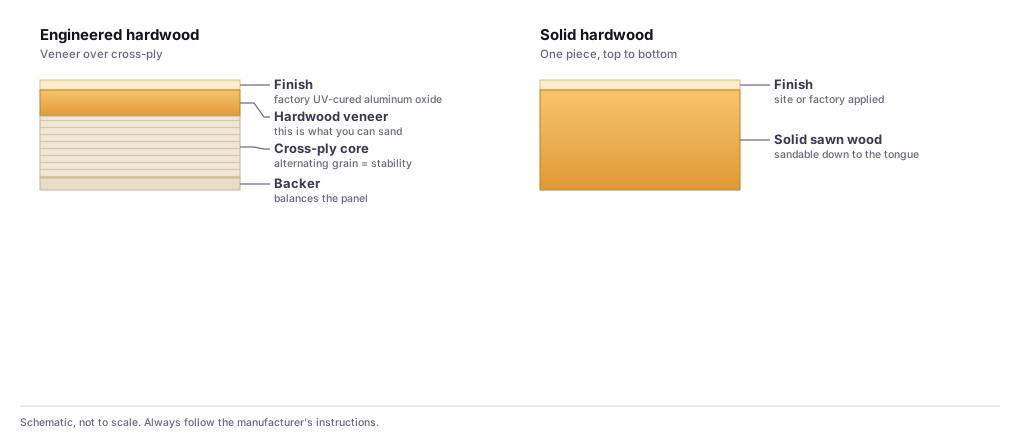
Both are real wood on the surface. Solid gives you the most refinishes and the longest life, but only over a wood subfloor above grade. Engineered goes where solid can't — over concrete, below grade, over radiant heat — and a thick-veneer engineered board isn't a compromise product.
Installed cost includes material and professional labor. Ratings are relative across all 21 materials on this site, not absolute scores.
| Solid Hardwood | Engineered Hardwood | |
|---|---|---|
| Installed cost per sq ft | $9.00–$22.00 | $9.00–$19.00 |
| Expected service life | 50–100 years | 20–50 years |
| Cost per sq ft per year | $0.21 | $0.40 |
| Durability | 4/5 | 4/5 |
| Water resistance | 1/5 | 2/5 |
| Comfort underfoot | 3/5 | 3/5 |
| Sound absorption | 2/5 | 3/5 |
| Ease of maintenance | 3/5 | 3/5 |
| DIY friendliness | 1/5 | 3/5 |
| Environmental profile | 4/5 | 4/5 |
| Traffic rating | Heavy | Heavy |
| Commercially rated | Yes | Yes |
The points that decide this in practice — not the spec sheet items that read well but rarely change anyone's mind.
Solid hardwood is typically 3/4 inch with roughly 1/4 inch of usable wood above the tongue — that is several sandings across a very long life. Engineered has a veneer over plywood or HDF, and the veneer is what you can sand. Under 2mm is effectively a one-time light screen at best. At 3mm you get a refinish or two. At 4 to 6mm you are in the same practical territory as solid for most households. Ask for the veneer thickness in millimeters and treat any answer that dodges the question as a red flag.
The cross-ply construction resists cupping and gapping when humidity swings, which is why it works over slabs and radiant heat. But the surface is the same wood as solid — it dents and scratches identically, because a white oak veneer and a white oak plank are the same material where your shoes meet it. People conflate stability with toughness; they are separate properties.
This is a moisture rule, not a style rule. Below-grade concrete carries vapor drive from the soil, and solid wood installed over it will cup, crown or buckle. Engineered over a proper moisture barrier is the correct specification. Test the slab before either product goes down — ASTM F2170 in-situ relative humidity is the test that matters, and skipping it is the most expensive shortcut in the trade.
Premium engineered with a thick veneer often costs more than mid-grade solid. Cheap engineered with a paper-thin veneer is inexpensive for a reason and should be compared against laminate or LVP, not against solid hardwood. The category name tells you very little about quality; the veneer spec tells you nearly everything.
$9.00–$22.00 per sq ft installed, lasting 50–100 years — about $0.21 per sq ft per year.
Wide planks (6"+) look current but move more seasonally. In a dry climate, expect visible winter gaps unless you humidify.
$9.00–$19.00 per sq ft installed, lasting 20–50 years — about $0.40 per sq ft per year.
Ignore the price tag and read the wear-layer spec. Two floors at the same price can differ by 25 years of service life.
Yes. The wear surface is a genuine hardwood veneer, so it looks and behaves like wood underfoot. What differs is the construction beneath — cross-layered plywood or HDF instead of a solid sawn plank — which makes it more dimensionally stable and suitable over concrete and radiant heat.
It depends entirely on the veneer thickness. Under 2mm, treat it as not refinishable beyond a light screen and recoat. Around 3mm, expect one or two refinishes. At 4 to 6mm, several — comparable to solid for most homeowners. Always ask for the number in millimeters rather than accepting "refinishable" as an answer.
Not as a normal practice. Solid wood over a slab risks cupping and buckling from vapor drive, particularly below grade. Engineered over a tested slab with an appropriate moisture barrier is the correct approach. If solid is non-negotiable, it requires a built-up plywood subfloor system, which adds height and cost.
Engineered hardwood is real wood that can be refinished and adds resale value. LVP is waterproof, cheaper and more…
Solid hardwood can be refinished five to eight times across a lifetime and carries the strongest resale premium in…
Hardwood is a multi-decade floor that can be refinished and adds resale value. Laminate is a wear-layer product at a…
Engineered hardwood is real wood that may be refinishable and adds resale value. Laminate is a photograph under a very…
Choose hardwood if you're staying long enough for the resale premium and repeated refinishing to pay off, and the room…
Choose tile if the room is wet, sits over radiant heat, or needs to survive decades without a second thought — nothing…